

Search Engine Evaluator Job is a specialised remote role where professionals review and improve how search engines understand, rank, and display online content. Evaluators analyse search queries, test search results, and rate their relevance, accuracy, and quality based on strict guidelines. Companies like Google, Bing, and AI driven search platforms rely on these human reviewers to refine their algorithms, remove misleading results, and deliver better search experiences. This job does not require coding skills, but it demands strong analytical thinking, attention to detail, and an understanding of how search intent works in real world searches.
As AI becomes deeply integrated into modern search engines, the demand for Search Engine Evaluator Jobs is rapidly increasing worldwide. These roles help train AI models, validate ranking systems, and ensure search engines provide trustworthy and context aware results. For individuals seeking a stable online career, this job offers flexibility, competitive pay, and long-term growth potential in the evolving digital economy. Platforms like Remote Online Evaluator connect skilled evaluators with global opportunities, making it easier to start and grow a professional career in search engine evaluation.
What is a Search Engine Evaluator

A Search Engine Evaluator is a professional who reviews and rates the quality of search engine results to help improve how search engines like Google, Bing, or Yahoo display information. Their main job is to check whether the search results shown for a particular query are accurate, relevant, and useful for real users. Instead of writing or developing algorithms, they work as human reviewers who test search outputs based on guidelines provided by the search engine companies. This role ensures that when someone searches for something online, they receive results that match their intent and provide reliable answers.
In simple terms, a Search Engine Evaluator acts as a quality controller for search engines. They analyze search results, ads, maps, and featured snippets to see if they are trustworthy and helpful. Their feedback is then used to train AI models and refine ranking algorithms, making search engines smarter and more user focused over time. This job is especially important in today’s AI driven world, where search engines rely on both automation and human insight to deliver the best possible search experience.
This type of work falls under the broader field of human review in AI systems, where real people help train and validate how AI and search engines behave
Why Search Engine Evaluators are Important
Search engines cannot rely only on automation. AI systems require continuous human feedback to stay accurate and fair. Evaluators ensure:
- Search engines understand what users truly mean.
- The top results are trustworthy and useful.
- Irrelevant or misleading pages are filtered out.
- New algorithms work correctly before being launched.
Without Search Engine Evaluators, AI search quality would decline, leading to incorrect or harmful results. That’s why this role is in high demand across the world.
What Does a Search Engine Evaluator Do
The job revolves around reviewing and rating search engine outputs. Your daily work typically includes:
1. Rating Search Results

You are given a search query (for example, best laptops for students) and multiple search results. You must decide:
- Which result is the most helpful
- Which result is irrelevant or low quality
- Does the result match what the user wants
2. Understanding User Intent
Search queries are not always clear. Evaluators analyze what the user is trying to find informational, navigational, or transactional.
3. Testing AI Accuracy
You check if the search engine’s ranking makes sense. For example, if a cooking query returns finance pages, that’s an error.
4. Scoring and Reporting
Every search result is scored based on:
- Relevance
- Accuracy
- Usefulness
- Trustworthiness
Your feedback helps AI models learn and improve.
Search Engine Evaluator Job Types
This role exists in different categories depending on the project:
| Evaluator Type | What They Do |
|---|---|
| Search Quality Evaluator | Rates Google/Bing search results |
| Ad Evaluator | Reviews whether ads match user intent |
| AI Response Evaluator | Validates chatbot or AI answers |
| Content Evaluator | Checks quality and factual accuracy |
Who Hires Search Engine Evaluators
The role is commonly offered by:
- Remote Online Evaluator
- Google’s evaluation vendors
- Microsoft AI partners
- AI training and labeling companies
- Digital marketing and AI research firms
Most of these jobs are fully remote and contract-based, allowing flexible working hours.
You can explore some of the top evaluator companies hiring globally and see which organisations are actively recruiting for AI and search quality evaluation roles.
Skills Required for Search Engine Evaluator Jobs
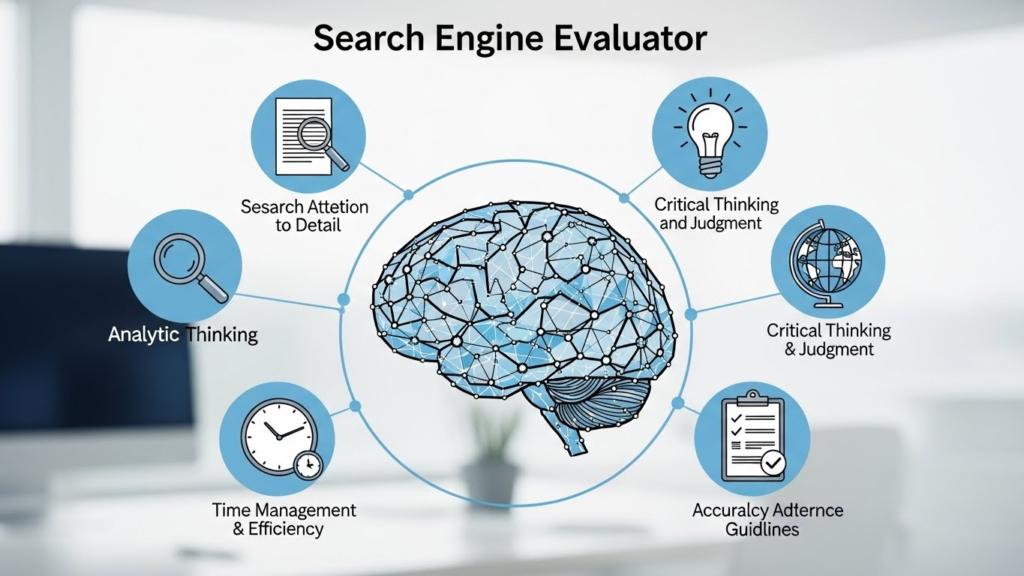
To succeed in this role, you need a mix of analytical and language skills.
Core Skills Needed
- Strong understanding of how search engines work.
- Ability to interpret user intent correctly.
- Excellent reading and comprehension skills.
- Good judgment to determine content relevance.
- Attention to detail when rating results.
Technical and Soft Skills
- Basic knowledge of SEO and keyword relevance.
- Ability to follow rating guidelines precisely.
- Internet research skills.
- Strong written communication.
- Consistency and accuracy in evaluation.
You don’t need programming skills but you must think like a search engine user.
How Much Do Search Engine Evaluators Earn
Pay depends on experience, region, and project type. On average:
| Level | Monthly Earnings |
|---|---|
| Beginner | $300 – $700 |
| Intermediate | $800 – $1,500 |
| Expert | $1,500 – $3,000+ |
Is Search Engine Evaluator a Good Career
Yes this is one of the most stable AI driven careers available today.
Benefits of This Role
- Fully remote work.
- Flexible schedules.
- High demand as AI grows.
- No advanced degree required.
- Entry-level friendly.
- Great for long-term career stability.
Unlike many digital jobs, this role cannot be replaced by automation because humans are needed to validate AI itself.
How to Get Hired as a Search Engine Evaluator

Getting hired is simpler than most people think. Here’s the step by step process:
Step 1: Learn Search Intent and Relevance
Understand how search engines rank pages. Study examples of relevant and irrelevant results.
Step 2: Improve Your Analytical Skills
Practice reviewing search results and rating their usefulness.
Step 3: Register on Evaluator Hiring Platforms
Companies like Remote Online Evaluator regularly post hiring opportunities.
Step 4: Pass the Evaluation Test
Most hiring companies require you to complete a short assessment to prove your ability.
Step 5: Start with Small Tasks and Grow
Begin with simple projects, improve accuracy, and earn more over time.
Tools Used by Search Engine Evaluators
- Search engine rating dashboards.
- AI evaluation portals.
- Task scoring systems.
- Web research and quality review platforms.
These tools guide you on what to review and how to score results.
Typical Work Environment
A typical work environment refers to the setting, culture, and conditions in which employees perform their daily tasks. It includes both the physical space such as offices, remote setups, or hybrid workplaces and the organisational atmosphere shaped by management style, communication patterns, and company values. A positive work environment encourages collaboration, clear expectations, and mutual respect, helping employees stay productive and engaged in their roles.
It also reflects how teams interact, how flexible the work structure is, and what kind of support employees receive. For example, some environments are fast paced and target driven, while others prioritise creativity, learning, and stability. A healthy work environment provides the right balance of accountability and encouragement, ensuring that employees feel motivated, valued, and aligned with the organisation’s goals.
Future of Search Engine Evaluator Jobs
Search engine evaluator jobs are becoming more important as search engines increasingly rely on artificial intelligence and machine learning to deliver accurate, relevant, and safe results. Instead of simply ranking websites, modern search platforms now generate direct answers, summaries, and recommendations through AI models. This shift creates a growing need for human evaluators who can test, review, and improve how these systems understand intent, detect misinformation, and handle sensitive content. As AI-driven search expands globally, evaluators play a critical role in maintaining quality, fairness, and trust across search experiences.
In the future, these roles are expected to evolve from basic rating tasks into more specialized positions involving data analysis, bias detection, model training feedback, and multilingual content validation. Companies will increasingly seek evaluators who understand user behaviour, search intent, and digital trends to help refine algorithms for different regions and industries. This makes search engine evaluator work a strong long term career path, especially for those aiming to stay relevant in the AI powered search and digital ecosystem.
How Remote Online Evaluator Helps You Get Started
Remote Online Evaluator connects professionals with global AI evaluation opportunities. We provide:
- Evaluator training
- Job listings and hiring guidance
- Skill improvement resources
- Remote career support
- AI response testing frameworks
If you want a full roadmap on working as a Search Engine Evaluator from home, explore our ultimate guide to working from home as a search engine evaluator
Conclusion
Search Engine Evaluator jobs are becoming one of the most reliable remote career paths in the AI-driven digital economy. As search engines increasingly depend on human judgment to improve accuracy, relevance, and fairness, evaluators play a vital role in shaping how information is ranked and presented online. This role not only offers flexible work opportunities but also allows professionals to build expertise in AI systems, digital quality control, and search behaviour analysis skills that are in growing global demand.
For anyone looking to work from home with a future focused career, becoming a Search Engine Evaluator is a smart step. With the right combination of analytical thinking, attention to detail, and familiarity with online trends, you can enter this field even as a beginner. As AI continues to expand across search platforms, companies will increasingly rely on trained evaluators to keep their systems accurate, unbiased, and user friendly, making this job both stable and rewarding for the long term.
FAQs
1. What does a Search Engine Evaluator do?
A Search Engine Evaluator reviews and rates search results to ensure they are accurate, relevant, and helpful for users. Their feedback helps search engines and AI models improve ranking quality and user experience.
2. What skills are needed for a Search Engine Evaluator job?
Key skills include strong analytical thinking, attention to detail, research ability, understanding of online behaviour, and basic familiarity with search engines and digital platforms.
3. How much can a Search Engine Evaluator earn?
Pay typically ranges from $10 to $25 per hour, depending on the company, project, and your experience level.
4. Is this a full time or part time job?
Most Search Engine Evaluator roles are remote and project-based, offering flexible part time schedules. Some companies may provide long term contracts for consistent work.
5. Do I need prior SEO or AI experience?
No. Many companies provide training. However, having basic SEO knowledge or digital research experience can increase your chances of getting hired.
6. How can I apply for Search Engine Evaluator jobs?
You can apply through companies like Appen, TELUS International AI, Lionbridge, Remotasks, and OneForma, or through specialized platforms like RemoteOnlineEvaluator.com.
7. Is the job suitable for beginners?
Yes. This job is beginner-friendly as long as you are comfortable working online, following guidelines, and learning evaluation standards.
8. What is the hiring process like?
Most companies require you to pass an online qualification test where you demonstrate your ability to analyze and rate search results based on provided guidelines.
9. Can this job lead to a long term career?
Absolutely. With experience, you can grow into roles like AI quality analyst, search relevance specialist, or SEO strategist, making it a strong long term opportunity.