

AI Systems are intelligent technologies designed to analyse data, learn patterns, and make decisions with minimal human intervention. These systems combine algorithms, machine learning models, and computing infrastructure to perform tasks such as predicting outcomes, understanding language, recognising images, automating workflows, and optimising business processes. From chatbots and recommendation engines to fraud detection, healthcare diagnostics, and autonomous vehicles, AI systems transform raw data into actionable intelligence that improves speed, accuracy, and scalability across industries.
What makes AI systems powerful is their ability to adapt and improve over time. Unlike traditional software, they continuously learn from new data, refine their predictions, and respond to changing environments. Modern AI systems integrate natural language processing, computer vision, and deep learning to deliver real-world results in marketing, finance, healthcare, education, cybersecurity, and operations. As organisations increasingly rely on automation and data-driven decision-making, understanding how AI systems work, where they are applied, and how they are governed has become essential for building competitive, reliable, and responsible digital solutions.
What Is Human Review in AI Systems
Human review refers to the process where people evaluate, validate, correct, or approve the outputs and decisions made by AI models before those outputs are used in critical workflows. It ensures that AI is accurate, ethical, compliant, and aligned with real-world context.
Human review typically operates in three models:
| Review Model | Description | Example Use |
|---|---|---|
| Human-in-the-Loop (HITL) | A human actively reviews or approves AI outputs before action is taken. | Medical diagnosis suggestions reviewed by a doctor |
| Human-on-the-Loop (HOTL) | AI operates automatically, but humans monitor performance and intervene if needed. | Fraud detection systems with analyst oversight |
| Human-over-the-Loop (HOVL) | Humans design rules, audits, and policies that govern AI behaviour. | Compliance teams setting AI governance frameworks |
These approaches ensure that AI remains a decision support tool rather than an unchecked decision maker a distinction also explored in AI evaluator vs automated systems
Why AI Alone Is Not Reliable
AI models do not “understand” the world. They predict outcomes based on patterns in data, which means their reliability depends entirely on the quality, completeness, and fairness of that data. Without human review, AI systems face five major limitations.
1. Hallucinations and Confident Errors
AI can generate answers that sound correct but are factually wrong. In healthcare, law, finance, and public information systems, such errors can cause serious harm.
2. Bias in Training Data
If historical data reflects social, gender, or racial bias, AI models can replicate or amplify it. Hiring algorithms, credit scoring tools, and predictive policing systems have already demonstrated this risk.
3. Lack of Context and Judgment
AI struggles with nuance: cultural sensitivity, ethical boundaries, legal interpretation, or rare edge cases that do not appear frequently in data.
4. Over Automation of Critical Decisions
When organisations trust AI outputs without verification, they risk:
- False medical recommendations
- Wrongful content takedowns
- Biased hiring decisions
- Financial compliance violations
5.Absence of Accountability
If a fully automated system makes a harmful decision, who is responsible? Without human oversight, accountability becomes unclear creating legal and reputational risks.
Why Human Review Still Matters in AI Systems
Human review transforms AI from a fast but fallible engine into a reliable, safe, and trustworthy system. It adds what machines fundamentally lack: judgment, ethics, responsibility, and contextual understanding.
Below are the core reasons human oversight remains essential.
1. Accuracy and Error Prevention
AI can process massive datasets, but it cannot verify truth the way humans do. Human reviewers:
- Validate predictions
- Check for anomalies
- Correct misclassifications
- Catch logic gaps
This is especially critical in domains where errors have real-world consequences.
| Domain | AI Role | Why Human Review Is Essential |
|---|---|---|
| Healthcare | Suggest diagnoses, analyse scans | Doctors confirm medical validity and patient safety |
| Finance | Detect fraud patterns | Analysts verify false positives before account actions |
| Legal | Summarise cases or contracts | Lawyers ensure interpretation aligns with law |
| HR | Screen resumes | Recruiters prevent discriminatory filtering |
This layered validation is central to professional AI evaluation roles
2. Bias Detection and Fairness
AI systems learn from historical data. If that data reflects inequality or skewed representation, AI can reproduce those patterns in:
- Hiring
- Credit scoring
- Insurance
- Content moderation
- Law enforcement tools
Humans play a critical role in:
- Auditing training datasets
- Identifying discriminatory outputs
- Adjusting decision thresholds
- Ensuring ethical alignment
Without human review, AI can silently reinforce unfair outcomes at scale.
3. Context, Ethics, and Judgment
AI cannot evaluate:
- Moral implications
- Cultural sensitivity
- Intent behind user actions
- Legal grey areas
For example:
- A content moderation AI may flag educational content as harmful.
- A chatbot may provide legally risky advice without disclaimers.
- A recommendation engine may optimise engagement at the cost of wellbeing.
Human reviewers add:
- Ethical reasoning
- Legal interpretation
- Cultural awareness
- Practical common sense
This makes AI responsible, not just efficient.
4. Safety, Compliance, and Regulation
Regulators increasingly demand human oversight for high-risk AI systems. Data protection, algorithmic accountability, and explainability laws require:
- Transparent decision processes
- Ability to audit AI outputs
- Human intervention in sensitive decisions
Human review ensures:
- GDPR compliance
- Industry regulation adherence (finance, healthcare, legal)
- Documentation for audits
- Ethical AI governance
AI without oversight is not just risky it is often non-compliant.
Where Human Review Is Essential

Healthcare
AI assists with imaging, diagnostics, and patient monitoring but doctors must validate all medical decisions to prevent misdiagnosis.
Finance
Fraud detection systems flag suspicious activity, but human analysts determine whether a transaction is actually fraudulent before action is taken.
Hiring and HR
AI tools rank candidates, but recruiters review results to avoid biased screening and ensure fair hiring practices.
Customer Support and Chatbots
AI handles routine queries, while humans manage escalations, emotional interactions, and complex problem resolution.
Content Moderation
Platforms use AI to detect harmful content, but human moderators review edge cases, appeals, and contextual content.
Human Review vs Fully Automated AI
The following comparison shows why human-reviewed AI consistently outperforms fully automated systems in trust and reliability.
| Factor | Fully Automated AI | AI with Human Review |
|---|---|---|
| Accuracy | Moderate | High |
| Bias Control | Weak | Strong |
| Context Awareness | Low | High |
| Compliance Readiness | Risky | Safe |
| Accountability | Unclear | Defined |
| Trust | Limited | Strong |
Human oversight does not slow AI down it makes its outputs dependable.
How to Integrate Human Review into AI Systems
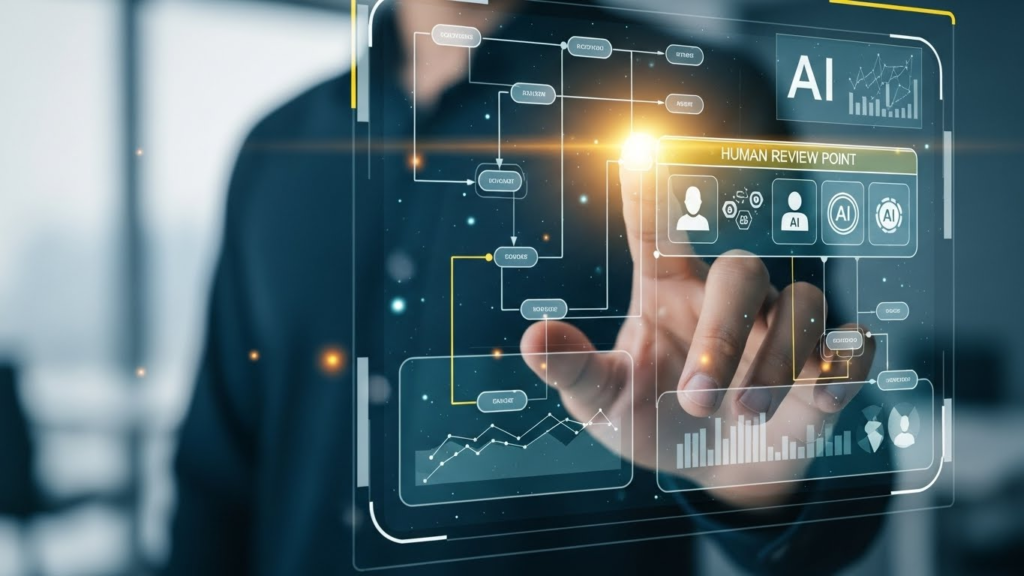
Organisations often assume that adding human oversight is complex. In reality, effective human-review frameworks follow simple principles.
1. Define Review Checkpoints
Identify high-risk outputs that require validation:
- Medical recommendations
- Financial decisions
- Hiring shortlists
- Legal summaries
- Moderation actions
2. Use Escalation Rules
Let AI handle low-risk cases while routing:
- Uncertain predictions
- Edge cases
- Policy-sensitive content
to human reviewers.
3. Implement Feedback Loops
Human corrections should feed back into:
- Model retraining
- Bias reduction
- Error pattern analysis
This improves AI performance over time.
4. Maintain Audit Trails
Log:
- AI decisions
- Human interventions
- Final outcomes
This ensures transparency and regulatory readiness.
How Human Review Improves LongTerm AI Performance
Human oversight does more than prevent mistakes it strengthens AI systems over time.
| Benefit | Impact on AI |
|---|---|
| Error correction | Reduces repeated mistakes |
| Bias identification | Improves fairness |
| Contextual training | Enhances real-world accuracy |
| Model evaluation | Supports safer deployment |
| Accountability | Builds user trust |
Human review creates a cycle of continuous improvement that pure automation cannot achieve.
Does Human Review Make AI More Trustworthy
Yes trust is built through:
- Transparency
- Explainability
- Ethical safeguards
- Human accountability
Users, regulators, and businesses are far more likely to adopt AI systems that include:
- Manual validation
- Review mechanisms
- Governance structures
AI that operates without oversight may be fast, but it is harder to trust, harder to regulate, and more likely to fail in critical scenarios.
Human Centred AI, Not Human Free AI
The future of artificial intelligence is not about replacing people. It is about augmenting human expertise with machine intelligence.
The most successful AI systems will:
- Automate repetitive tasks
- Surface insights
- Increase efficiency
But humans will continue to:
- Make final decisions
- Define ethical boundaries
- Interpret complex scenarios
- Ensure fairness and accountability
AI works best when it supports human judgment not when it attempts to replace it.
Conclusion
AI systems are powerful, fast, and increasingly accurate but they are not infallible. Human review remains essential to ensure fairness, context, and accountability in decisions that affect people, businesses, and society. From detecting bias in training data to validating real-world outcomes, human oversight provides the judgment and ethical reasoning that machines still lack. Without it, even advanced AI can amplify errors, misinterpret intent, or make decisions that are technically correct but practically harmful.
As AI becomes more embedded in healthcare, finance, hiring, content moderation, and autonomous systems, human review is not a limitation it is a safeguard. The most effective AI systems are not fully automated; they are human in the loop. By combining machine efficiency with human responsibility, organisations can build AI that is not only intelligent, but also trustworthy, transparent, and aligned with real-world values.
FAQs
1.Why is human review important in AI systems?
Human review ensures accuracy, fairness, and ethical decision-making. It helps detect bias, correct errors, and validate outputs in sensitive areas like healthcare, finance, hiring, and content moderation.
2.What is human in the loop in AI?
Human-in-the-loop (HITL) means humans actively monitor, evaluate, and intervene in AI processes. This approach improves model reliability, prevents harmful outcomes, and supports responsible AI deployment.
3.Can AI systems operate safely without human oversight?
In low-risk tasks, AI may function independently. However, in high-impact domains such as medical diagnosis, legal decisions, financial approvals, or public safety—human oversight is critical to avoid serious mistakes.
4.How does human review improve AI accuracy?
Reviewers verify outputs, flag incorrect predictions, and provide feedback that improves future model training. This continuous evaluation reduces error rates and strengthens real-world performance.
5.Does human review slow down AI systems?
While it adds a layer of verification, modern workflows integrate review efficiently. The small time investment is outweighed by reduced risk, higher trust, and better decision quality.
6.What risks occur when AI is not reviewed by humans?
Unreviewed AI can produce biased results, hallucinate information, misclassify data, or make ethically questionable decisions leading to legal issues, reputational damage, and user harm.
7.Which industries most need human review in AI?
Healthcare, finance, recruitment, law, education, content moderation, autonomous systems, and customer service all require human oversight due to regulatory, ethical, and safety concerns.
8.Is human review only needed during training?
No. Human review is essential during data labelling, model evaluation, live deployment, and post deployment monitoring to ensure ongoing accuracy and fairness.
9.How does human oversight support AI compliance and governance?
It helps meet regulatory standards, ensures transparency in decision-making, and provides audit trails that demonstrate responsible AI usage.
10.Will AI ever replace human review completely?
Not in high risk or ethically sensitive areas. As AI grows more advanced, human judgment will remain necessary to interpret context, manage exceptions, and uphold accountability.