

Human feedback is important in AI training because it helps machines understand real human intent, context, and quality expectations. While artificial intelligence can process large amounts of data, it often lacks the ability to judge accuracy, relevance, tone, and usefulness the way humans do. By adding human feedback into the training process, AI systems become more reliable, safe, and aligned with real world needs.
In modern AI systems, especially large language models and recommendation engines, human feedback acts as a correction layer. It improves model performance by guiding outputs, reducing errors, and making responses more helpful and natural. Without human input, AI may produce misleading or low quality results, which can affect trust, usability, and business outcomes.
What Is Human Feedback in AI Training
Human feedback in AI training refers to the process where real people evaluate, correct, and guide AI outputs to improve performance. It involves tasks such as rating responses, correcting mistakes, labeling data, and giving quality signals to the model.
This process ensures that AI systems learn not only from raw data but also from human judgment. It helps bridge the gap between machine predictions and real user expectations. As a result, AI becomes more accurate, meaningful, and aligned with human values.
How AI Models Learn Without Human Feedback
AI models are initially trained using large datasets through machine learning algorithms. They identify patterns, relationships, and probabilities in data to generate predictions or responses. This process is efficient but lacks understanding of context, ethics, and user intent.
Without human feedback, AI systems can produce biased, irrelevant, or incorrect outputs. They may also struggle with tone, clarity, and decision making in complex scenarios. This is why relying only on data is not enough for building high quality AI systems.
Role of Human Feedback in AI Training

Human feedback plays a critical role in refining AI systems after initial training. It helps models learn what is correct, useful, and appropriate in different situations. This feedback is often used in processes like reinforcement learning and supervised fine tuning.
By continuously evaluating and improving AI outputs, human feedback ensures better performance over time. It also helps reduce errors, improve safety, and align AI behavior with user expectations and business goals.
Types of Human Feedback Used in AI
There are multiple forms of human feedback used in AI training, each serving a specific purpose. These methods help improve different aspects of model performance.
Key Types of Human Feedback
- Data labeling and annotation
Humans tag and classify data to help AI understand patterns - Output ranking
Humans compare multiple outputs and rank the best one - Error correction
Humans fix incorrect responses to improve model learning - Reinforcement signals
Humans provide feedback on what is good or bad - Content moderation
Humans ensure outputs meet safety and ethical standards
Each type of feedback contributes to building a more accurate and reliable AI system.
Human Feedback vs Automated Training
| Factor | Human Feedback | Automated Training |
|---|---|---|
| Accuracy | High due to human judgment | Depends on data quality |
| Context Understanding | Strong | Limited |
| Bias Control | Can reduce bias | May amplify bias |
| Cost | Higher | Lower |
| Scalability | Limited | Highly scalable |
Benefits of Human Feedback in AI Training
Human feedback offers several advantages that significantly improve AI systems. It ensures that models deliver better results and meet user expectations.
Key Benefits
- Improves accuracy and relevance
AI responses become more precise and useful - Enhances user experience
Outputs feel more natural and human like - Reduces bias and errors
Human review helps identify and fix issues - Increases trust and reliability
Users feel confident using AI systems - Supports continuous improvement
AI keeps getting better with ongoing feedback
These benefits make human feedback a critical part of AI development.
Real World Applications of Human Feedback in AI

Human feedback is used in many real world AI systems to improve accuracy and usability. In chatbots and virtual assistants, human reviewers help refine responses so they sound natural and relevant. This ensures users get helpful answers instead of generic or confusing replies.
It is also widely used in search engines, recommendation systems, and healthcare tools. Human input helps improve ranking quality, personalise suggestions, and support safe decision making. One of the most direct examples of this is the search engine evaluator job, where trained professionals review and rate search results to help AI systems understand real user intent. This makes AI systems more reliable and aligned with real user needs.
Common Applications
- Chatbots and virtual assistants
Improving conversation quality and relevance - Search engines
Enhancing result accuracy and ranking - Content generation tools
Ensuring clarity, tone, and usefulness - Recommendation systems
Providing better suggestions based on user behavior - Healthcare AI
Ensuring accurate diagnosis support and safety
These applications highlight how human feedback improves real world AI systems.
Human in the Loop AI Training Process
Human in the loop is a process where humans continuously guide AI systems during training. After the model generates outputs, humans review them, provide corrections, and rank responses based on quality. This feedback is then used to improve the model step by step.
Over time, this cycle of training and feedback helps AI learn better patterns and behaviours. It ensures that the system evolves with human expectations, leading to more accurate, safe, and context aware results.
Process Overview
| Step | Description |
|---|---|
| Data Collection | Gather large datasets |
| Initial Training | Train model using algorithms |
| Human Evaluation | Humans review outputs |
| Feedback Integration | Improve model using feedback |
| Continuous Learning | Repeat the process for refinement |
Challenges of Using Human Feedback in AI
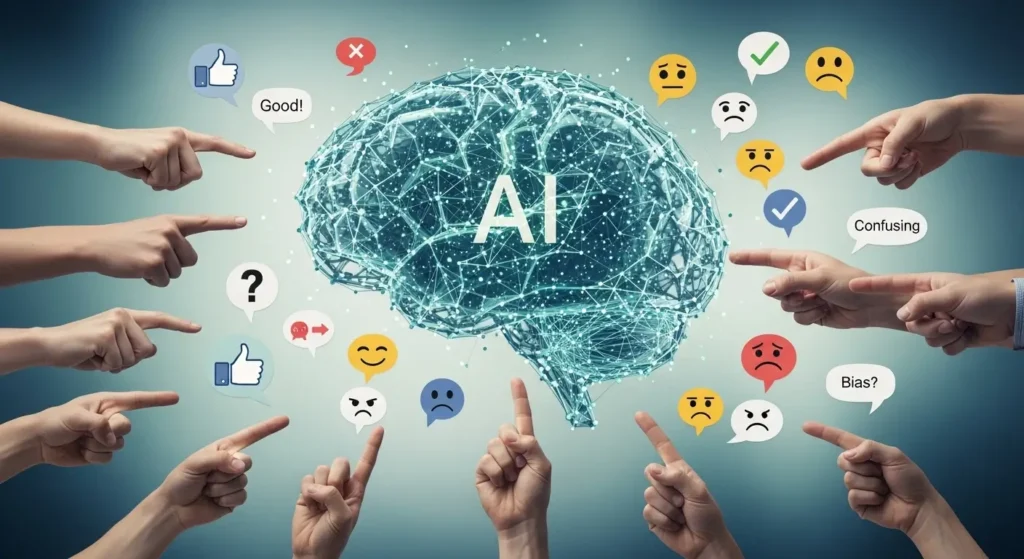
One of the main challenges of human feedback is cost and time. Involving skilled human reviewers requires resources, which can slow down the training process compared to automated methods. It also becomes difficult to scale when dealing with large datasets.
Another challenge is inconsistency in feedback. Different reviewers may have different opinions, which can affect training quality. Maintaining standard guidelines and quality control is important to ensure reliable and consistent results.
Key Challenges
- High cost and time consumption
Human involvement requires resources - Inconsistency in feedback
Different people may have different opinions - Scalability issues
Difficult to apply at large scale - Training quality control
Requires skilled reviewers
Despite these challenges, the benefits of human feedback outweigh the limitations.
Best Practices for Using Human Feedback in AI Training
Following these practices leads to better AI performance and results. For those interested in entering this field professionally, exploring top companies hiring for digital evaluation work is a practical next step to understand where human feedback roles are in highest demand globally. To maximize the value of human feedback, it is important to follow best practices. These strategies help improve efficiency and outcomes.
Best Practices
- Use clear guidelines for reviewers
Ensure consistent feedback - Combine human and automated methods
Balance efficiency and quality - Train human evaluators
Improve accuracy and reliability - Continuously update datasets
Keep AI relevant and accurate - Monitor performance regularly
Identify and fix issues quickly
Following these practices leads to better AI performance and results.
Future of Human Feedback in AI Training
The future of human feedback in AI training will focus on better collaboration between humans and machines. Advanced tools will help collect feedback more efficiently, reducing time and cost while maintaining high quality results.
AI systems will also become better at learning from smaller but high quality human inputs. This will allow faster improvements and more personalised experiences. Human feedback will continue to play a key role in making AI more trustworthy and aligned with human values.
Human Feedback vs AI Autonomy
| Aspect | Human Feedback Driven AI | Fully Autonomous AI |
|---|---|---|
| Control | Human guided | Machine driven |
| Reliability | Higher | Variable |
| Ethical Alignment | Strong | Risky |
| Adaptability | Balanced | High but unpredictable |
Conclusion
Human feedback is important in AI training because it helps machines understand what is accurate, relevant, and useful from a human perspective. While AI can process large amounts of data, it cannot naturally judge context, tone, or real user intent. Human input acts as a quality filter that corrects mistakes, improves responses, and ensures the output aligns with real world expectations.
It also plays a key role in making AI systems more reliable, safe, and trustworthy. By guiding models through feedback, ranking, and corrections, humans help reduce bias, improve decision making, and enhance overall performance. This combination of machine learning and human judgment is what allows AI to deliver meaningful and high quality results. For anyone looking to participate in this process as a professional, reviewing the best search engine evaluator jobs is an excellent starting point to find verified, flexible opportunities in the growing AI evaluation industry.
FAQs
1.What is human feedback in AI training
Human feedback is when people review, rate, and correct AI outputs to improve performance. It helps AI learn what is accurate, useful, and aligned with real user expectations.
2.Why is human feedback important in AI training
Human feedback improves accuracy, reduces errors, and adds real world understanding to AI systems. It ensures AI outputs are relevant, safe, and helpful for users.
3.How does human feedback improve AI models
Humans guide the model by correcting mistakes and ranking better responses. This helps the AI learn patterns of high quality answers and improve over time.
4.What is human in the loop in AI
Human in the loop is a training method where humans continuously evaluate and refine AI outputs. It creates a feedback cycle that improves model performance step by step.
5.Can AI work without human feedback
AI can work without human feedback, but its quality may be limited. Without human input, models may produce inaccurate, biased, or less useful results.
6.What are examples of human feedback in AI
Examples include data labeling, response ranking, error correction, and content moderation. These actions help train AI systems to perform better in real world scenarios.