

AI Content Evaluator is a human led quality control role where trained reviewers assess AI-generated and online content for accuracy, relevance, usefulness, and safety. Instead of creating content, an AI Content Evaluator judges whether information truly satisfies user intent, follows platform guidelines, and meets trust standards. Search engines, chatbots, voice assistants, and recommendation systems rely on this human feedback to improve rankings, reduce misinformation, and deliver reliable results. In simple terms, when AI produces content, the AI Content Evaluator ensures it is helpful, credible, and aligned with real user needs.
The demand for AI Content Evaluators continues to grow as AI-generated content expands across search engines and digital platforms. Companies prioritise human judgement to maintain content quality, meet compliance requirements, and improve user experience especially as automated systems alone cannot fully detect bias, context errors, or low-value information. Because search engines reward helpful and trustworthy content, AI Content Evaluators play a key role in shaping AI systems that align with Google’s quality standards and AI Overview results, making this role increasingly valuable for first-page visibility and long-term digital accuracy.
What Is an AI Content Evaluator?
An AI Content Evaluator is a trained reviewer who assesses content produced by artificial intelligence systems. This content may include search results, chatbot responses, voice assistant answers, ad copy, summaries, or recommendation outputs. A deeper explanation of this role is available in the ultimate guide to AI training evaluators.
The evaluator’s job is to determine whether the AI output:
- Answers the user’s question correctly
- Matches search intent
- Is accurate and trustworthy
- Avoids bias, harm, or misinformation
- Follows platform and policy guidelines
Unlike writers or developers, AI Content Evaluators focus purely on quality judgement. Their feedback is used to train, fine-tune, and correct AI models so that future responses improve.
A Typical Day in the Life of an AI Content Evaluator

While tasks may vary slightly by company or project, most AI Content Evaluators follow a structured daily workflow. The work is task-based, guideline-driven, and designed to ensure consistency.
Starting the Day
A typical day begins by logging into an evaluation platform. Evaluators usually see:
- Assigned task batches
- Task instructions or updated guidelines
- Expected quality benchmarks
Before starting, evaluators carefully read the guidelines. These documents explain what “good” and “bad” content looks like for that specific task. Missing small details here can affect accuracy scores later.
This preparation stage is essential because AI evaluation is about following standards, not personal opinions.
Reviewing AI-Generated Content
The main part of the day is spent reviewing AI outputs. Each task presents:
- A user query or prompt
- One or more AI-generated responses
The evaluator must judge how well the AI response satisfies the user’s intent.
Typical evaluation questions include:
- Does this answer directly address the question?
- Is the information correct and complete?
- Is the tone appropriate and neutral?
- Could the content mislead or cause harm?
Evaluators assign ratings based on predefined scales such as “Highly Relevant,” “Partially Helpful,” or “Low Quality.”
Fact-Checking and Verification
Accuracy matters more than speed. Many daily tasks require evaluators to verify facts using reliable sources. This may include:
- Checking dates, names, or statistics
- Verifying medical, financial, or legal claims
- Confirming whether sources are trustworthy
Evaluators do not rely on memory alone. They are expected to research carefully and judge credibility. This is one of the key reasons human evaluators remain necessary.
Flagging Issues and Policy Violations
Another daily responsibility is identifying problematic content. Evaluators flag AI outputs that contain:
- Misinformation
- Bias or discrimination
- Unsafe advice
- Inappropriate language
- Policy violations
This feedback helps prevent low-quality or harmful content from being promoted or repeated by AI systems.
Submitting Tasks and Monitoring Performance
At the end of each batch, evaluators submit their ratings. Many platforms provide performance dashboards showing:
- Accuracy scores
- Guideline adherence
- Task completion consistency
Evaluators often review feedback from quality audits. These audits help improve judgement and ensure alignment with evaluation standards.
Daily Workflow Of AI Content Evaluator
| Time Block | What the Evaluator Does | Purpose |
|---|---|---|
| Start of Day | Log into evaluation platform, review task instructions | Understand quality standards |
| Early Tasks | Read updated guidelines and examples | Avoid rating errors |
| Mid-Day Work | Evaluate AI responses, assign ratings | Improve AI accuracy |
| Research Phase | Fact-check answers using trusted sources | Prevent misinformation |
| Final Tasks | Submit completed tasks and reviews | Feed data back into AI systems |
| End of Day | Review performance scores or feedback | Improve future accuracy |
Common Daily Tasks Handled by AI Content Evaluators

Although projects vary, most evaluators perform a combination of the following tasks daily:
- Rating search engine results for relevance
- Evaluating chatbot answers for clarity and correctness
- Comparing multiple AI responses and selecting the best one
- Reviewing summaries generated by AI tools
- Assessing ad content for compliance and usefulness
- Judging voice assistant responses for accuracy
Each task focuses on improving how AI systems understand and respond to human queries.
Tools and Platforms Used in Daily Work
AI Content Evaluators typically use internal evaluation platforms provided by the hiring company or contractor. These platforms include:
- Task dashboards
- Rating interfaces
- Guideline documentation
- Feedback and scoring systems
In addition, evaluators frequently use:
- Search engines for research
- Authoritative reference websites
- Internal policy manuals
No coding or technical tools are required. The focus remains on analysis, judgement, and consistency. To stay efficient and consistent, many also reference comparisons of the best online job reviewer tools used across different evaluation projects.
Skills Required for Daily AI Content Evaluation
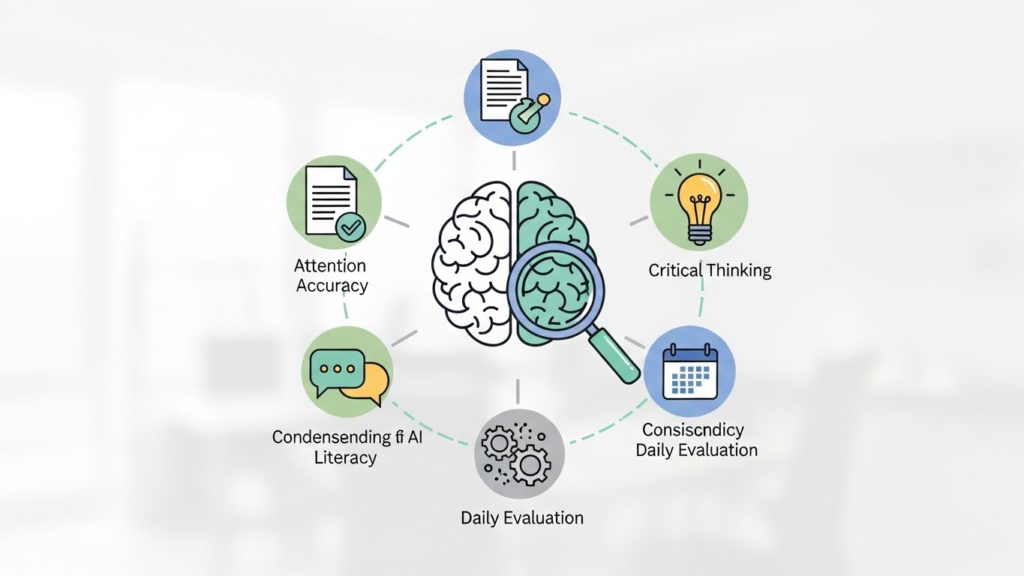
Success as an AI Content Evaluator depends on human skills rather than technical expertise. Key daily skills include:
Strong Reading and Comprehension Skills
Strong reading and comprehension skills help a person clearly understand guidelines, instructions, and complex content. This ensures tasks are completed accurately without missing important details. It also allows evaluators to interpret meaning, tone, and context correctly.
Critical Thinking
Critical thinking enables logical judgement instead of surface-level decisions. It helps identify errors, bias, or misleading information by analysing content deeply. This skill is essential for making fair and objective evaluations.
Research Ability
Research ability allows a person to verify facts using reliable and trustworthy sources. It helps confirm accuracy, relevance, and credibility of information. Strong research skills reduce the risk of approving incorrect or outdated content.
Attention to Detail
Attention to detail ensures even small mistakes, inconsistencies, or guideline violations are noticed. This improves overall content quality and evaluation accuracy. It is especially important when following strict evaluation criteria.
Understanding User Intent
Understanding user intent means knowing what a user is actually trying to find or achieve. It helps judge whether content truly satisfies the user’s query. This skill improves relevance, usefulness, and overall user experience.
How Performance Is Measured on a Daily Basis
AI Content Evaluator performance is not measured by speed alone. Most platforms prioritise quality.
Daily or weekly metrics may include:
- Accuracy score based on benchmark answers
- Agreement with expert evaluations
- Guideline compliance rate
- Consistency over time
High-quality evaluators receive more tasks and long-term project access.
Performance Metrics Used in AI Evaluation
| Metric | What It Measures | Why It’s Important |
|---|---|---|
| Accuracy Score | Agreement with benchmark answers | Maintains data quality |
| Guideline Compliance | Correct use of evaluation rules | Prevents model errors |
| Consistency | Stable ratings over time | Improves AI training |
| Task Completion | Reliability and availability | Ensures workflow continuity |
Work Structure
AI Content Evaluation work is usually:
- Remote
- Task-based
- Flexible
Evaluators may choose when to work, depending on task availability. Some projects offer hourly pay, while others pay per task.
Daily workloads vary. Some evaluators work a few hours a day, while others treat it as a part-time or full-time remote role.
Is the Work Repetitive?
The structure is consistent, but the content varies. Evaluators review different queries, topics, and AI outputs daily. While the evaluation framework remains the same, the thinking required stays fresh.
Those who enjoy analytical work and structured tasks often find the role engaging rather than monotonous.
Why AI Content Evaluators Are Still Essential

Despite advances in AI, machines cannot fully judge quality on their own. AI lacks real-world understanding, ethical reasoning, and contextual awareness.
Human evaluators help:
- Improve search relevance
- Reduce misinformation
- Enforce content standards
- Train safer and more accurate AI systems
Major platforms, including those associated with Google, continue to rely on human evaluation to maintain content quality and user trust.
Who Should Consider Becoming an AI Content Evaluator?
This role is ideal for:
- Students seeking flexible income
- Freelancers wanting stable online work
- Remote workers without technical backgrounds
- Professionals interested in AI without coding
Strong English comprehension and research skills matter more than degrees or certifications.
Career Growth Opportunities

Daily AI content evaluation can lead to:
- Senior evaluator roles
- Quality analyst positions
- AI training and operations roles
- SEO and content quality careers
Many evaluators build transferable skills in search intent, content analysis, and digital quality control. Many evaluators progress by following guidance such as how to become a successful remote online evaluator in 2026
Conclusion
An AI Content Evaluator’s daily work is structured, thoughtful, and impactful. By reviewing and rating AI-generated content, evaluators play a direct role in shaping how AI systems serve users worldwide.
The job requires patience, critical thinking, and attention to detail not technical expertise. As AI continues to expand into everyday life, the demand for skilled human evaluators remains strong.
For anyone looking to work remotely, contribute to AI development, and earn online without coding, AI Content Evaluation offers a practical and future-relevant opportunity.
FAQs
1. What is an AI Content Evaluator?
An AI content evaluator is a professional who reviews, rates, and assesses digital content generated or ranked by artificial intelligence systems. Their role is to judge accuracy, relevance, usefulness, and safety based on strict guidelines provided by AI companies and search platforms.
2. What does an AI Content Evaluator do daily?
On a daily basis, an AI content evaluator reviews AI-generated text, search results, ads, or chatbot responses. Typical tasks include checking factual accuracy, matching content to user intent, flagging harmful or misleading information, and submitting quality ratings through an evaluation platform.
3. Is an AI Content Evaluator the same as a content writer?
No. An AI content evaluator does not create content. Instead, they analyse and judge existing content produced by AI systems or algorithms. Their focus is quality control, not writing or publishing.
4. What types of content do AI Content Evaluators review?
AI content evaluators review search results, chatbot replies, voice assistant answers, advertisements, product descriptions, social media text, and training data used to improve AI models.
5. What skills are needed to become an AI Content Evaluator?
Key skills include strong reading comprehension, attention to detail, logical thinking, basic research ability, and an understanding of online content quality. No coding or technical background is usually required.
6. How many hours do AI Content Evaluators work per day?
Most AI content evaluators work on a flexible schedule. Daily work can range from 1 to 6 hours depending on task availability, performance scores, and the platform’s workload.
7. How are AI Content Evaluators paid?
Payment is typically task-based or hourly. Rates vary by region and task type, but many evaluators earn between USD 10 and USD 25 per hour, depending on accuracy and experience.
8. Do AI Content Evaluators need prior experience?
No formal experience is required. Most platforms provide training materials and qualification tests. Strong attention to guidelines and consistent performance matter more than previous job experience.
9. Are AI Content Evaluator jobs remote?
Yes. AI content evaluator roles are fully remote and can be done from home. All work is completed online through secure evaluation portals.
10. What tools do AI Content Evaluators use daily?
Evaluators typically use web-based dashboards, guideline documents, research tools like search engines, and task submission portals provided by evaluation companies.