

Artificial intelligence (AI) is the simulation of human intelligence processes by computer systems, enabling machines to learn, reason, and make decisions with minimal human intervention. From voice assistants like Siri and Alexa to self driving cars and medical diagnostics, artificial intelligence is reshaping every major industry across the globe. It encompasses key technologies including machine learning, deep learning, natural language processing (NLP), and computer vision. As AI adoption accelerates, businesses and governments are leveraging its power to automate complex tasks, reduce costs, and unlock new levels of efficiency and innovation.
The rapid advancement of artificial intelligence is not just a technological shift it is a fundamental transformation in how humans interact with the world around them. AI systems today can analyze massive datasets in seconds, generate human like text, detect diseases earlier than doctors, and even predict market trends with remarkable accuracy. According to leading research firms, the global artificial intelligence market is projected to exceed $1.8 trillion by 2030, making it one of the fastest growing sectors in history. Whether you are a student, a business owner, or a policy maker, understanding artificial intelligence is no longer optional it is essential for navigating the future.
What Is AI Trust Scoring
AI trust scoring is a multi dimensional evaluation framework used to assess whether an AI system performs reliably, fairly, and transparently. Trust scores are typically built from several measurable and qualitative dimensions, including the system’s accuracy, consistency, interpretability, resistance to bias, and alignment with ethical standards. These scores help organizations, regulators, and end-users make informed decisions about when and how to deploy AI systems.
Unlike a single performance metric such as accuracy, a trust score encapsulates a holistic picture of an AI model’s behaviour across varied conditions. It answers questions such as Does the model perform equally well across different demographic groups Can its decisions be explained in plain language? Does it behave predictably when it encounters new or unusual data These are not purely technical questions they are deeply human ones.
Table 1: Key Components of AI Trust Scoring
| Trust Component | Definition | Human Role | Automation Level |
|---|---|---|---|
| Accuracy Score | How often the AI output is factually correct | Validates edge cases | High |
| Bias Detection | Identifying discriminatory or skewed outputs | Defines fairness criteria | Medium |
| Explainability | Ability to explain AI decisions in plain language | Interprets outputs | Low |
| Ethical Alignment | Conformity to societal and organizational values | Sets value framework | Very Low |
| Contextual Relevance | Appropriateness of AI response to specific scenarios | Provides domain context | Medium |
Why Human Judgment Is Essential
1. Defining What Trust Means
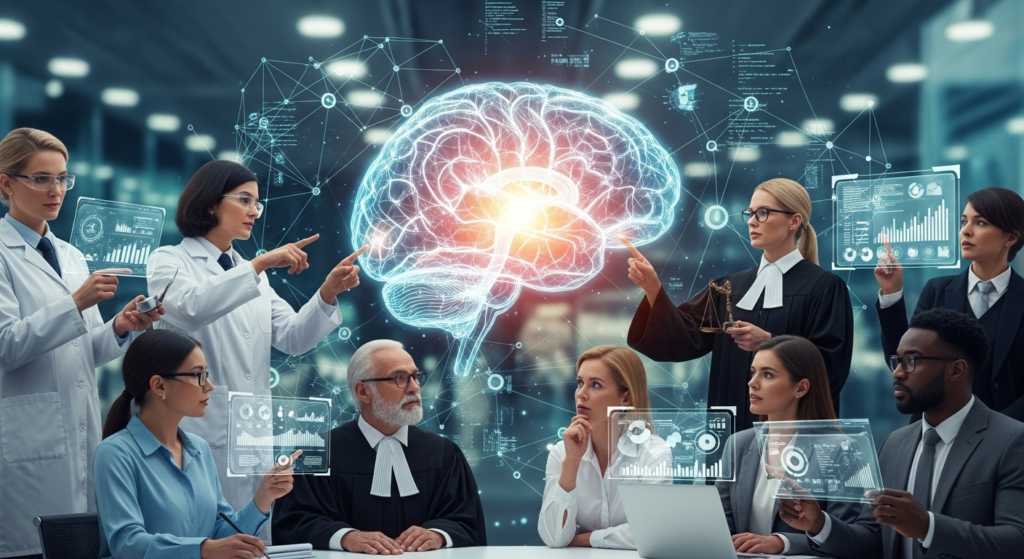
Before any scoring can begin, someone must define what it means for an AI system to be trustworthy in a specific context. This is not a technical problem it is a values problem. A trust score for an AI used in parole decisions should weight fairness and civil rights heavily. A trust score for a weather prediction model might focus more on statistical accuracy and reliability. Only human experts ethicists, domain specialists, affected communities, and legal professionals can establish these contextually appropriate definitions.
2. Identifying Subtle Bias and Unfairness
Automated bias detection tools can flag statistical disparities across demographic groups, but they cannot determine whether a disparity constitutes harmful discrimination in a given cultural or legal context. Human reviewers bring the moral reasoning and lived experience needed to make that judgment. For example, an AI hiring tool might show lower match scores for candidates from certain universities an automated tool might not flag this if the disparity falls within predefined thresholds, but a human reviewer recognizes it as a proxy for socioeconomic discrimination.
3. Interpreting Ambiguous Outputs
Many AI decisions involve inherent ambiguity. A content moderation system, for instance, must distinguish between satire and genuine hate speech, between artistic expression and harmful content. These distinctions require cultural knowledge, contextual reading, and human moral judgment that no automated scoring system can reliably replicate at scale. These types of evaluations are part of the broader AI content review process, where human reviewers apply contextual reasoning, cultural understanding, and ethical judgment that automated systems cannot replicate reliably.
4. Ensuring Accountability
Trust ultimately implies accountability. When an AI system causes harm whether a wrongful denial of a loan, a misdiagnosis, or an unjust sentencing recommendation there must be a human being or institution that can be held responsible. Automated trust scoring systems, by contrast, diffuse responsibility in ways that make accountability nearly impossible. Human oversight creates a clear chain of responsibility.
Key Principles of Human Centered Trust Scoring
Effective integration of human judgment in AI trust scoring rests on several core principles that organizations and researchers have identified through practice:
- Transparency: Humans must have meaningful access to the AI system’s logic and data before they can evaluate it fairly.
- Diversity of Reviewers: Trust scoring panels should include diverse stakeholders engineers, domain experts, ethicists, and representatives from affected communities.
- Iterative Review: Human judgment should not be a one-time audit but an ongoing, iterative process that responds to how the AI system evolves over time.
- Structured Criteria: While human review is qualitative, it should be guided by structured frameworks and rubrics to ensure consistency and comparability.
- Documentation: All human review decisions should be documented with clear reasoning to enable future audits and to support appeals processes.
- Independence: Human reviewers should be sufficiently independent from the teams that developed the AI system to avoid conflicts of interest.
- Feedback Integration: The findings of human reviewers should be systematically fed back into the AI development process to drive continuous improvement.
Table 2: Human Judgment vs. Automated Scoring
| Evaluation Dimension | Human Judgment | Automated Scoring |
|---|---|---|
| Speed | Slow — requires deliberate review | Fast — processes thousands of outputs per second |
| Consistency | Variable — depends on reviewer experience | Highly consistent within defined rules |
| Nuance Detection | Excellent — catches tone, context, cultural subtleties | Limited — struggles with ambiguity and cultural nuance |
| Ethical Reasoning | Strong — applies moral reasoning and lived experience | Absent — no genuine moral reasoning capability |
| Scalability | Poor — not feasible for large-scale deployment | Excellent — scales easily with minimal added cost |
| Cost Efficiency | Expensive — requires skilled annotators | Cost-effective after initial setup |
| Accountability | Clear — humans can be held responsible | Diffuse — difficult to assign responsibility |
Industry Applications and Human Oversight

The role of human judgment in AI trust scoring is not abstract it manifests in concrete, high-stakes decisions across virtually every major industry. Understanding how human oversight operates in practice helps illustrate why it cannot be replaced by automation alone. These evaluation responsibilities are often carried out by trained professionals working in structured roles such as
remote AI evaluator jobs, where human reviewers assess AI outputs for accuracy and quality.
Healthcare: When Algorithms Advise Clinicians
In healthcare, AI systems are increasingly used to support diagnostic imaging, predict patient deterioration, and recommend treatment plans. Trust scoring in this domain requires human clinicians to review not only the technical accuracy of AI predictions but also their clinical appropriateness. A model that is 95% accurate in a research dataset may perform very differently on patients from underrepresented ethnic groups or with comorbidities not well-represented in training data. Only clinicians with domain expertise can catch these nuances and judge whether a system is genuinely trustworthy in their specific patient population.
Finance: Fairness in Credit and Risk
Financial AI systems that assess creditworthiness, detect fraud, or manage risk portfolios carry significant implications for economic equity. Automated scoring tools can measure accuracy and consistency, but human risk officers and compliance teams must evaluate whether the model’s behavior aligns with anti-discrimination laws and internal fairness standards. Regulators in many jurisdictions now require that financial institutions provide explainable, human-reviewable justifications for AI-driven credit decisions — precisely because automated metrics alone are insufficient to establish legal compliance and public trust.
Criminal Justice: The Stakes of Algorithmic Sentencing
Perhaps nowhere is the role of human judgment more critical than in criminal justice. Tools like recidivism prediction algorithms have been widely criticized for reinforcing racial disparities. While these tools provide numerical risk scores, judges must exercise independent human judgment to determine how much weight those scores should carry in sentencing decisions. Trust scoring in this domain requires lawyers, civil rights advocates, and affected community members to evaluate the tool’s impact on real people not just its statistical performance on historical datasets.
Table 3: Human Judgment in AI Trust Scoring Across Key Industries
| Industry | Trust Score Focus | Human Judgment Applied | Outcome Impact |
|---|---|---|---|
| Healthcare | Diagnostic accuracy | Clinicians review AI-flagged diagnoses before decisions | Patient safety, liability |
| Finance | Credit risk & fraud | Risk officers validate AI-assigned credit scores | Lending fairness, compliance |
| Criminal Justice | Recidivism prediction | Judges retain final sentencing authority | Civil rights, fairness |
| Hiring & HR | Candidate suitability | HR reviewers check for bias in AI shortlisting | Diversity, legal compliance |
| Content Moderation | Harmful content detection | Human moderators review borderline AI flags | Free speech, user safety |
Challenges in Integrating Human Judgment
Despite its indispensable value, integrating human judgment into AI trust scoring is not without significant challenges. Recognizing and addressing these challenges is essential to designing trust scoring systems that are both rigorous and practical.
- Scalability Constraints: AI systems can generate millions of outputs per day, making comprehensive human review logistically and financially impractical. This requires organizations to develop intelligent sampling strategies that focus human review where it matters most.
- Reviewer Bias: Human reviewers bring their own biases, assumptions, and blind spots. Without structured review frameworks and diverse reviewer panels, human oversight can itself become a source of bias rather than a corrective for it.
- Expertise Gaps: Effective trust scoring often requires rare combinations of technical, ethical, legal, and domain-specific expertise. Finding and retaining qualified reviewers is a persistent challenge for organizations deploying AI at scale.
- Reviewer Fatigue: Sustained engagement in trust scoring work particularly in high stakes domains like content moderation can lead to reviewer fatigue and declining quality over time.
- Inconsistency Across Reviewers: Different human reviewers may reach different conclusions about the same AI output, introducing variability that can undermine the reliability of trust scores.
- Institutional Resistance: In many organizations, the costs and time associated with robust human review are perceived as barriers to deployment speed, creating institutional pressure to minimize or bypass human oversight.
Organizations address these challenges by using structured workflows such as those described in AI models , which combine automated evaluation with targeted human review.
The Future: Human AI Collaboration in Trust Scoring

The future of AI trust scoring lies not in choosing between human judgment and automated evaluation, but in designing thoughtful collaboration between the two. Humans bring moral reasoning, cultural sensitivity, contextual expertise, and accountability. Automated systems bring speed, consistency, and scalability. Used together, they are far more powerful than either alone.
Emerging approaches to this collaboration include active learning systems, where human reviewers focus their attention on the cases where automated scoring is most uncertain or where the stakes are highest. Explanation-first AI design, where systems are engineered to produce human-interpretable rationale for every decision, makes human review more efficient and more meaningful. Participatory evaluation frameworks actively involve affected communities in defining what trust means in a given context, ensuring that scoring reflects the values of those most impacted by AI decisions.
Regulatory frameworks are also evolving to formalize the role of human judgment. The European Union’s AI Act, for instance, requires mandatory human oversight for high-risk AI applications, establishing a legal baseline that mirrors best practice in the most responsible organizations. As AI systems grow more powerful and more pervasive, these regulatory requirements are likely to expand rather than contract.
Conclusion
Artificial intelligence has transformative potential, but potential alone does not justify trust. Trust must be earned and it must be evaluated by those with the wisdom, authority, and accountability to make that judgment. AI trust scoring is, at its core, a human enterprise. It requires people to define values, identify harms, weigh trade offs, and take responsibility for the consequences of deployment decisions.
Automated metrics are powerful tools in support of this enterprise, but they are not substitutes for it. As organizations scale their AI deployments, the temptation to automate trust evaluation as well as AI output must be firmly resisted. Human judgment is not an obstacle to efficient AI deployment it is the foundation upon which genuine, durable AI trust is built. Societies that get this balance right will be the ones that harness AI’s benefits while protecting their most important values: fairness, dignity, and accountability.