
Remote Local SEO vs Traditional Local SEO is the difference between ranking based on digital authority versus physical location. Traditional local SEO depends on having a real office, Google Maps listings, and proximity to the searcher, while remote local SEO allows businesses to rank in cities they do not operate from by using content, brand trust, and topical relevance. In 2026, Google increasingly favours relevance and credibility over street level distance.
The reason Remote Local SEO vs Traditional Local SEO has become so important is because Google AI now evaluates who is most capable of serving a user, not who is closest. Service based businesses, agencies, and online brands can now appear in local results through entity authority, location focused content, and strong digital signals, while traditional map based SEO still serves walk-in businesses. This shift is redefining how modern brands grow across multiple cities without opening physical offices.
What Is Traditional Local SEO
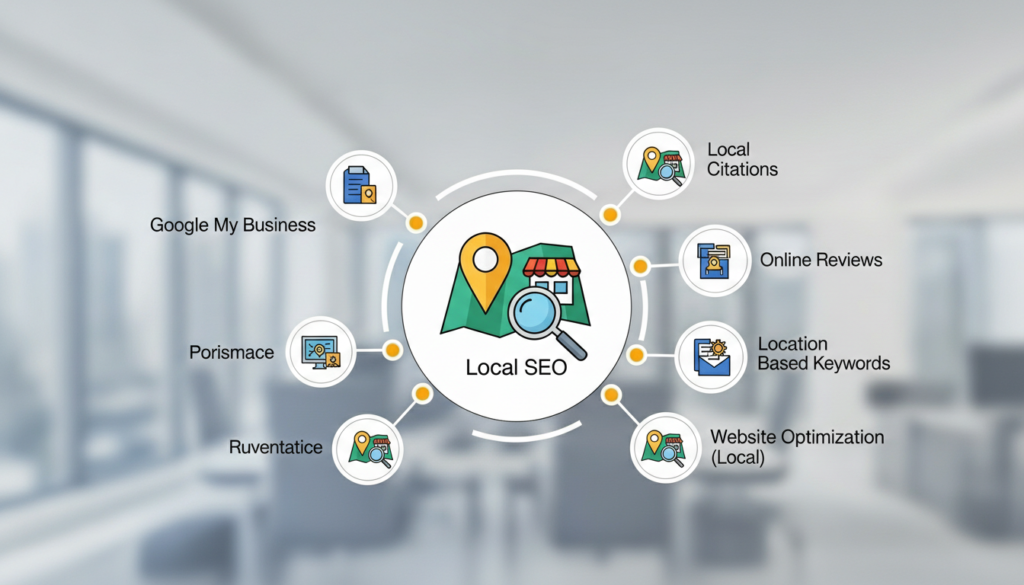
Traditional local SEO is a location based strategy that helps businesses rank in Google Maps and local search results by using a physical office, Google Business Profile, local citations, and customer reviews. It is designed for businesses that rely on walk in traffic or in person visits, such as restaurants, clinics, retail shops, and salons, where proximity to the customer plays a major role in ranking. This is the same ranking system Google uses when evaluating businesses in proximity searches, similar to how Google AI overview checks content quality for relevance and trust.
It is designed for businesses that:
- Serve walk in customers
- Need foot traffic
- Operate from a fixed location
This model revolves around:
- Google Business Profile
- Physical address
- Local citations
- Reviews
- Google Maps ranking
If someone searches:
Dentist near me
Google assumes the best answer is the closest real world location.
This is why restaurants, salons, gyms, clinics, and shops still rely on this model.
But this approach has a major limitation.
It only works when location matters more than capability.
What Is Remote Local SEO
Remote local SEO allows businesses to rank in cities where they do not have a physical office by using digital authority, content relevance, and brand signals instead of street-level proximity. This strategy is ideal for service-based businesses, agencies, consultants, SaaS companies, and online brands that serve clients remotely and need visibility across multiple locations.
It allows a company to rank in:
- Cities
- States
- Countries
even if they have no physical office there.
It is designed for:
- SEO agencies
- Marketing firms
- SaaS platforms
- Consultants
- Lawyers
- Coaches
- E commerce brands
Remote local SEO focuses on:
- Entity authority
- Topical relevance
- Localised content
- Digital brand presence
- Backlinks
- User trust
Instead of telling Google:
We are located here
You tell Google:
We are trusted to serve users here.
How Google Now Decides Local Rankings
Google now decides local rankings by evaluating trust, relevance, topical authority, and brand signals rather than just physical distance. Its AI analyses which businesses are most capable of solving a user’s problem based on content, reputation, mentions, engagement, and entity recognition, allowing remote brands to appear in local results when they demonstrate strong relevance. This process mirrors how Google evaluates information quality usinghuman review and AI scoring systems
It ranks:
- Which brands are mentioned
- Which brands are relevant
- Which brands solve the query
When someone searches:
SEO agency in Singapore
Google looks at:
- Who talks about Singapore
- Who is associated with SEO
- Who is trusted by users
- Who appears in authoritative content
This allows companies without offices to outrank companies with offices.
That is why remote local SEO is now so powerful.
Core Differences
| Factor | Traditional Local SEO | Remote Local SEO |
|---|---|---|
| Physical office | Required | Not required |
| Google Business Profile | Central | Optional |
| Maps ranking | Primary | Secondary |
| Content | Minimal | Strategic |
| Brand authority | Low impact | High impact |
| AI visibility | Weak | Strong |
| Scalability | Limited | High |
Why Traditional Local SEO Is Losing Power
Traditional local SEO is losing power because it was built for a time when Google could only understand addresses and proximity, not service capability. As more businesses operate online and serve clients remotely, Google AI has shifted toward ranking the most trusted and relevant brands rather than simply the closest ones.
It assumes:
- People only want nearby businesses
- Google trusts addresses
- Reviews equal quality
But modern search has changed.
Google now understands:
- Service delivery
- Remote work
- Brand authority
- Reputation
A marketing agency in London can serve Manchester.
A lawyer in Toronto can serve Vancouver.
A SaaS company in New York can serve Sydney.
Google no longer limits relevance to geography.
When Traditional Local SEO Still Wins
Traditional local SEO still works best for businesses that require physical visits, such as restaurants, cafes, medical clinics, gyms, and retail stores. In these cases, Google Maps and proximity-based rankings remain the strongest factors because users need a place they can physically go to.
Traditional local SEO still dominates in:
- Restaurants
- Cafes
- Clinics
- Retail shops
- Walk-in services
If customers must physically visit you, proximity matters.
Google Maps still rules those industries.
When Remote Local SEO Wins
Remote local SEO wins when services can be delivered online, over the phone, or through digital platforms. Businesses such as marketing agencies, law firms, software companies, and consultants benefit more from building authority and relevance across cities than relying on physical locations.
Remote local SEO dominates when:
- Services are delivered online
- Calls, Zoom, or software replace visits
- Customers care more about quality than distance
This includes:
- Agencies
- Consultants
- B2B services
- SaaS
- Digital platforms
In these markets, authority beats distance.
Which Businesses Should Use What
| Business Type | Best Strategy |
|---|---|
| Restaurant | Traditional |
| Dentist | Traditional |
| Hair salon | Traditional |
| Law firm | Remote |
| SEO agency | Remote |
| Marketing firm | Remote |
| SaaS company | Remote |
| Online coach | Remote |
| National service provider | Remote |
How Google AI Evaluates Remote Local SEO
Google AI evaluates remote local SEO by analysing how often a brand is mentioned, how deeply it covers a topic, how users interact with it, and how strongly it is associated with specific locations through content and backlinks. These signals allow Google to understand whether a business is relevant to a city even without a physical presence.
Google AI looks at:
- Brand mentions
- Content depth
- User engagement
- Backlinks
- Topical authority
It builds an entity profile of your business.
If Google believes:
This brand is relevant for users in this city
You rank even without an address.
Why Most Businesses Still Fail at Remote SEO
Most businesses fail because they try to fake signals instead of building real authority which is exactly what Google penalises in AI quality scoring systems. Without strong content, genuine brand mentions, and trust signals, Google AI does not recognise them as legitimate local options.
Bad remote SEO:
- Fake offices
- Virtual addresses
- Thin location pages
This gets penalised.
Good remote SEO:
- Real authority
- Real content
- Real brand signals
This requires strategy, not shortcuts.
What Google AI Actually Uses
| Signal | Importance in 2026 |
|---|---|
| Physical address | Low |
| Google Business Profile | Medium |
| Content depth | Very high |
| Brand mentions | High |
| Topical authority | Critical |
| Backlinks | Still strong |
| User behaviour | Extremely important |
| AI readable structure | Mandatory |
Which Strategy Is Right for You
The right strategy depends on how your business serves customers: if people must visit your location, traditional local SEO is best, but if you deliver services remotely and want to grow in multiple cities, remote local SEO offers far greater reach and scalability.
Choose Traditional Local SEO if:
- You need walk in traffic
- You rely on Maps
- Customers visit you
Choose Remote Local SEO if:
- You serve multiple cities
- You operate digitally
- You want to scale
The Future of Local SEO

The future of local SEO is shifting away from physical location and moving toward trust, relevance, and digital authority. Googles AI now focuses more on which brand can best serve a user rather than which business is closest, making content quality, brand signals, and topical expertise more important than ever.
As search becomes more AI driven, businesses that build strong online credibility and location based relevance will be able to rank across multiple cities without physical offices. This change is creating new growth opportunities for service based and digital brands that invest in long term authority rather than just map listings.
Conclusion
Remote Local SEO vs Traditional Local SEO is no longer just a technical comparison it reflects how Google itself has evolved. Traditional local SEO still works for businesses that depend on foot traffic and physical visits, but it is limited by geography. As search becomes more AI driven, Google increasingly rewards relevance, authority, and trust rather than just proximity.
Remote local SEO opens the door for service based and digital businesses to grow across cities and countries without opening new offices. By building strong topical authority, location focused content, and brand signals, companies can appear in local searches wherever their customers are. In the future of search, digital presence matters more than physical location.
FAQs
1. What is the main difference between Remote Local SEO and Traditional Local SEO?
Traditional local SEO depends on a physical office and Google Maps rankings, while remote local SEO relies on digital authority and content to rank in locations without a physical presence.
2. Can a business rank in a city without having an office there?
Yes. With remote local SEO, businesses can rank by building strong location based relevance, brand trust, and topical authority.
3. Does Google allow remote local SEO?
Yes. Google allows service area businesses to rank as long as they do not misrepresent their location and build genuine digital relevance.
4. Which businesses benefit most from Remote Local SEO?
Agencies, consultants, SaaS companies, law firms, and other service based businesses benefit the most because they can serve clients remotely.
5. Is Traditional Local SEO still useful?
Yes. It remains essential for restaurants, clinics, shops, and other businesses that require customers to visit a physical location.
6. Which strategy is more future-proof?
Remote local SEO is more future-proof because it aligns with how Google AI evaluates trust, relevance, and service capability rather than just physical proximity.