
Online nursing instructor jobs remote are rapidly becoming one of the most in demand career paths for experienced nurses in 2026. As nursing schools expand their digital programs to meet growing healthcare demands, qualified RNs and advanced practice nurses are being actively recruited to teach theory, clinical reasoning, and specialty courses all from home. Whether you hold a BSN, MSN, or DNP, remote nursing faculty positions are available across adjunct, part time, and full time formats at community colleges, for profit universities, and major online nursing programs nationwide.
Finding legitimate online nursing instructor jobs remote requires knowing where to look, what credentials employers expect, and how to position yourself as an academic candidate not just a clinical one. Top hiring platforms like HigherEdJobs, Indeed, LinkedIn, and university career portals list hundreds of remote nursing educator openings year-round. With an active RN license, at least 2–3 years of clinical experience, and a willingness to engage students through platforms like Canvas or Blackboard, you can launch a rewarding second career in nursing education on your own schedule, from anywhere.
Why Remote Nursing Instructor Jobs Are Booming in 2026
The online education sector has experienced explosive growth over the past several years, and nursing education is no exception. The American Association of Colleges of Nursing (AACN) has consistently reported a shortage of nursing faculty a gap that remote positions are uniquely positioned to fill.
Several factors are driving this growth:
- Nursing school enrollment continues to rise as healthcare demand increases globally
- Telehealth normalization has made healthcare professionals more comfortable with virtual platforms
- Universities are reducing physical overhead by expanding online program offerings
- The COVID-19 pandemic permanently shifted nursing education infrastructure toward digital delivery
- Adjunct and part-time remote roles allow working nurses to teach without leaving clinical practice
This convergence of factors means that in 2026, the job market for online nursing instructors is robust, diverse, and genuinely accessible to qualified candidates. At the same time, remote-first hiring trends across industries have made professionals more comfortable working digitally. If you’re comparing different types of remote work opportunities, you can also explore careers in remote customer service roles.
What Qualifications Do You Need
Before you start applying, it’s important to understand what most institutions are looking for. Requirements vary depending on whether you’re applying for an adjunct, full-time, or clinical simulation role.
Minimum Education Requirements by Role Level
| Role Type | Minimum Education | Preferred Education | Licensure Required |
|---|---|---|---|
| Adjunct Nursing Instructor | BSN (for LPN programs); MSN preferred | MSN or DNP | Active RN License |
| Full-Time Online Faculty | MSN | DNP or PhD in Nursing | Active RN License |
| Clinical Simulation Educator | BSN + Clinical Experience | MSN with Simulation Cert | Active RN License |
| Nursing Program Director | MSN | DNP/PhD | Active RN License + Admin Experience |
In most cases, if you hold an active RN license and at minimum a Bachelor of Science in Nursing (BSN), you can qualify for entry-level adjunct positions at community colleges and vocational nursing schools. However, for university level roles particularly those teaching in BSN, MSN, or DNP programs you’ll typically need at minimum an MSN.
Other Key Qualifications Employers Look For
- Clinical experience: Most programs require at least 2–5 years of hands-on nursing experience
- Teaching experience: Prior teaching, precepting, or mentoring experience is a major plus
- Technology proficiency: Familiarity with Learning Management Systems (LMS) like Canvas, Blackboard, or Moodle
- Specialty certifications: Certifications like CCRN, CEN, or specialty-specific credentials strengthen your profile
- Curriculum development skills: The ability to design modules, assessments, and rubrics is increasingly valued
Step by Step Guide to Finding Remote Nursing Instructor Jobs in 2026
Step 1: Assess and Update Your Credentials

Start by taking a realistic inventory of your qualifications. Pull out your nursing license verification, your transcripts, and your CV. Ask yourself:
- Is my RN license current and active in the right states (or do I need a Nurse Licensure Compact state)?
- Do I meet the educational requirements for the roles I want?
- Do I have documented teaching or precepting experience?
If you need to strengthen your credentials, consider completing an online teaching certification programs like the Nurse Educator Certificate from the National League for Nursing (NLN) or university-based online teaching courses can make your application significantly more competitive. Even a single graduate-level course in curriculum design or educational theory helps.
Step 2: Build a Strong Academic CV
A nursing instructor CV is different from a clinical nursing resume. Academic employers want to see:
- Education section listed first (with degrees, institution, graduation dates)
- Licensure and certifications clearly listed
- Teaching experience — even informal precepting, staff education, or community health teaching counts
- Publications or presentations, if any
- Professional affiliations (AACN, NLN, ANA, specialty nursing organizations)
- Clinical experience with specific specialties noted
Keep your CV format clean, professional, and at least 2 pages if you have the experience to justify it. Academic hiring committees expect detail.
Step 3: Know Where to Search The Best Job Boards
Not all job boards are created equal when it comes to remote nursing faculty roles. Below is a breakdown of the most effective platforms for your search in 2026.
| Job Platform | Best For | Key Features |
|---|---|---|
| HigherEdJobs.com | University & college faculty roles | Largest dedicated academic job board in the US |
| Indeed.com | Broad range including for-profit schools | High volume; filter by “remote” and “nursing faculty” |
| Networking + job listings | Strong for connecting with department chairs directly | |
| Chronicle of Higher Education | Research-intensive academic positions | Prestigious postings, less for-profit focused |
| NursePower.net | Nursing-specific job listings | Niche platform dedicated to nursing career openings |
| SimplyHired | Adjunct and part-time positions | Good for finding community college adjunct roles |
| WGU Careers (Western Governors University) | Fully online university-specific | WGU consistently hires remote nursing faculty |
| University websites directly | Institution-specific openings | Best for targeting preferred schools |
Pro tip: Set up job alerts on at least 3 platforms using keywords like “online nursing instructor,” “remote nursing faculty,” “adjunct nursing,” and “nurse educator remote.” This way, new postings land in your inbox the moment they go live.
Step 4: Target the Right Types of Institutions

Not every school hires remote nursing faculty. Knowing which types of institutions to focus on saves you considerable time.
For profit online universities like Grand Canyon University, Chamberlain University, Western Governors University, and Capella University hire remote nursing faculty regularly and often post openings year-round.
Community colleges are increasingly offering hybrid and online LPN and ADN programs and frequently hire adjunct instructors remotely for didactic (theory) courses even when clinical components remain on-site.
Traditional state universities with online divisions particularly large state systems like the University of Phoenix Online, or public universities with established distance education programs hire remote faculty, though competition can be more intense.
Specialty education companies that offer continuing education (CE) content for nurses also hire subject matter experts and instructors on a contract basis.
When researching institutions, treat the process similarly to how candidates evaluate remote staffing agencies for legitimate job placement.
Step 5: Craft a Targeted Cover Letter
Your cover letter for a nursing instructor position should speak the language of education, not just clinical care. Emphasize:
- Why you are passionate about nursing education
- Specific teaching or mentoring experiences you’ve had
- Your familiarity with online teaching tools and platforms
- How your clinical expertise directly supports the courses you’d be teaching
- Your understanding of the institution’s mission (do your research on each school)
A generic cover letter will hurt more than help. Tailor every single application.
Step 6: Prepare for the Interview Process
Academic hiring processes tend to be more formal than clinical nursing interviews. Here’s what to expect:
- Phone or video screening with HR
- Committee interview with multiple faculty members and possibly the program director
- Teaching demonstration: You may be asked to present a short mock lesson (15–20 minutes) on a nursing topic prepare one in advance
- Questions about pedagogy: Be ready to discuss your teaching philosophy, how you handle struggling students, and your experience with online platforms
Practice your teaching demonstration ahead of time. Choose a topic you know deeply something like “SBAR communication in clinical handoff” or “pathophysiology of sepsis for nursing students” and present it clearly as if teaching to a class of nursing students.
What Can You Expect to Earn
Salary for remote nursing instructors varies significantly based on institution type, role (adjunct vs. full-time), and educational level.
| Position | Employment Type | Annual Salary Range (2026 Est.) |
|---|---|---|
| Adjunct Nursing Instructor | Part-Time / Per Course | $3,000–$6,000 per course |
| Online Nursing Instructor (For-Profit) | Full-Time | $58,000–$80,000/year |
| University Online Nursing Faculty | Full-Time | $75,000–$110,000/year |
| DNP/PhD-Level Online Professor | Full-Time | $95,000–$130,000+/year |
| Nursing Program Online Director | Full-Time | $100,000–$145,000+/year |
Many nurses start with adjunct work teaching one or two courses per semester on a per-course pay structure while keeping their clinical jobs. This is a smart strategy because it builds your teaching portfolio and helps you understand whether full-time education is right for you before making the leap.
Tips to Stand Out as a Candidate
The market is competitive, particularly for full-time roles at well-regarded institutions. Here are practical ways to differentiate yourself:
- Get certified as a Nurse Educator (CNE) through the National League for Nursing it signals serious commitment to the education track
- Publish or present at nursing conferences even a poster presentation adds academic credibility
- Develop sample course materials having a ready-made syllabus, sample quiz, or module outline to show interviewers demonstrates initiative
- Join professional organizations like the NLN, AACN, or specialty nursing groups members often hear about openings before they’re publicly posted
- Build a LinkedIn presence that reflects your educator identity, not just your clinical career connect with nursing faculty and follow nursing school pages
- Volunteer as a guest lecturer for a local community college online program to gain documented teaching experience quickly
Balancing Remote Teaching with Clinical Practice
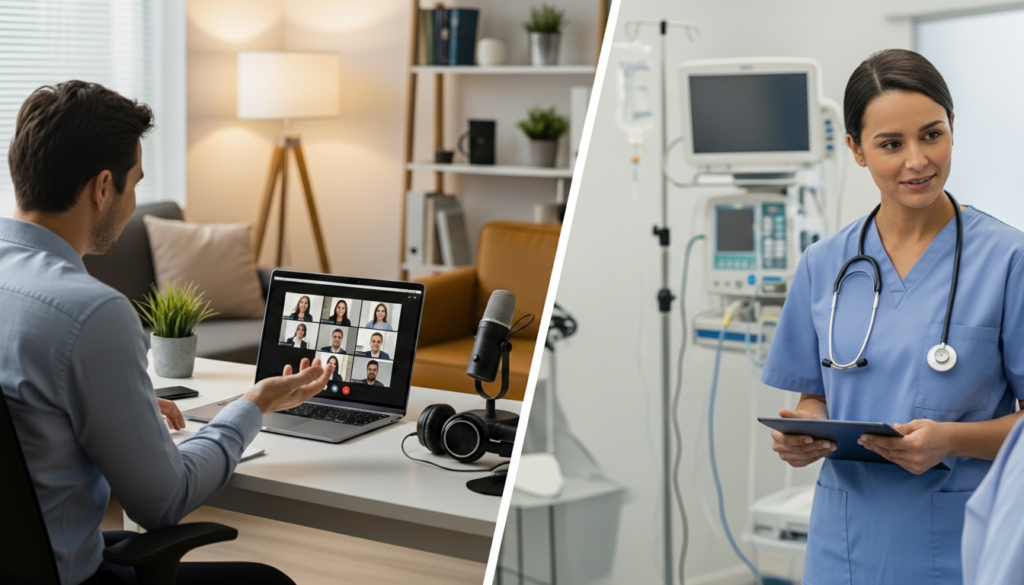
One of the biggest advantages of remote nursing instructor jobs is the flexibility they offer. Many nurses successfully combine part-time teaching with clinical work, which keeps their skills sharp while building their academic careers.
If you go the adjunct route, here’s how to manage both effectively:
- Set dedicated “office hours” in your teaching schedule so students know when to expect responses
- Batch your grading into specific blocks of time rather than checking in constantly
- Communicate proactively with your clinical employer about your teaching schedule most are supportive
- Use asynchronous teaching formats whenever possible they give you the flexibility to engage with students on your own time
Many experienced nurses find that teaching actually makes them better clinicians by forcing them to revisit foundational principles and articulate the reasoning behind clinical decisions.
Final Thoughts
Finding a remote nursing instructor job in 2026 is a realistic and achievable goal for nurses with the right credentials and the right approach. The key is to start with a clear picture of where you stand qualifications-wise, build a strong academic-focused application package, search the right platforms consistently, and approach interviews with confidence in your clinical expertise and your passion for teaching the next generation of nurses.
The nursing education field needs people like you experienced, dedicated, and ready to make a difference beyond the bedside. Take the first step today, and you could be shaping the future of nursing from your home office before the year is out.