

AI Evaluator Work is the human-led process of reviewing, testing, and validating AI-generated content, search results, chatbot responses, and automated decisions to ensure they are accurate, relevant, safe, and aligned with real user intent. AI Evaluators assess whether information is trustworthy, unbiased, useful, and compliant with platform quality standards. In simple terms, while AI systems generate answers, it is AI Evaluator Work that decides whether those answers actually deserve to be shown to users. This role directly influences how search engines rank content, how AI assistants respond to questions, and how misinformation is filtered from digital platforms.
As AI expands across search, e-commerce, customer support, and decision-making systems, AI Evaluator Work has become essential for quality control, compliance, and user trust. Automated models alone cannot fully understand context, nuance, or real-world relevance. Human evaluation ensures AI outputs meet ethical guidelines, accuracy benchmarks, and user experience standards. This makes AI Evaluator Work a critical layer behind AI Overviews, voice search results, and recommendation engines helping platforms deliver content that is not only fast, but genuinely helpful, credible, and aligned with what users are actually searching for.
What Is AI Evaluator Work
AI evaluator work refers to the process of assessing, reviewing, and improving AI-generated or AI-assisted content and decisions. Unlike content creators who produce text, images, or responses, AI evaluators focus on quality control. Their job is to judge whether AI outputs are accurate, relevant, helpful, unbiased, and safe for users.
AI evaluators operate in many environments: For a deeper breakdown of everyday responsibilities, you can explore what an AI content evaluator does on a daily basis
- Search engines assessing ranking quality
- Chatbots verifying response accuracy
- Content moderation systems filtering harmful material
- Recommendation engines ensuring relevance
- AI training teams improving model behaviour
Rather than building algorithms, evaluators provide human judgement that guides how AI systems learn, adjust, and improve. Their feedback is used to fine-tune models, correct errors, and align outputs with platform standards and user intent.
Manual vs Automated
The confusion around whether AI evaluation is manual or automated comes from how advanced modern AI appears. Machines can classify text, detect patterns, identify spam, and even predict user intent at enormous scale. From the outside, this makes it seem as though evaluation itself must be automated.
However, the reality is more nuanced. While AI systems are powerful at processing volume, they struggle with:
- Context and nuance
- Cultural understanding
- Ethical judgement
- Bias recognition
- Factual verification in complex or sensitive topics
These limitations mean that automation alone cannot ensure trust, accuracy, or fairness, especially in high-impact areas such as health, finance, law, education, and public information.
What Parts of AI Evaluation Are Automated
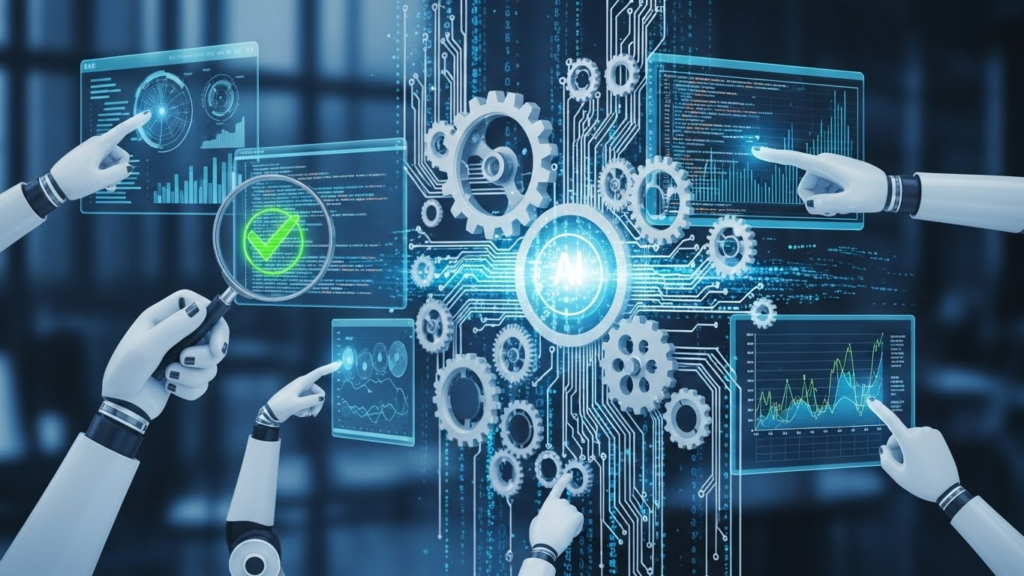
Automation plays a major role in modern AI evaluation. Without it, large-scale platforms would not be able to process billions of interactions daily. Automated evaluation focuses on speed, consistency, and pattern recognition.
1. Spam and Low Quality Detection
AI systems automatically identify:
- Duplicate content
- Keyword stuffing
- Clickbait patterns
- Machine-generated spam
- Irrelevant or off-topic material
These checks operate in milliseconds and help remove low-value content before human review is required. Many platforms also use specialised tools for these checks, such as those discussed in AI training task evaluator tools for data accuracy
2. Toxicity and Safety Filtering
Algorithms scan for:
- Hate speech
- Harassment
- Explicit content
- Violent language
- Policy violations
This allows platforms to flag or block harmful material instantly, protecting users at scale.
3. Language Classification and Tagging
Automated tools categorise:
- Topic areas
- Sentiment (positive, negative, neutral)
- Language and region
- Content type (review, informational, transactional)
These classifications help route content to the correct evaluation pipeline.
4. Performance Metrics and Scoring
AI systems track:
- Engagement rates
- Click behaviour
- Bounce patterns
- Query relevance
These signals contribute to automated scoring models that estimate usefulness and relevance across massive datasets.
Summary of Automated Functions
Automation excels at:
- High-speed processing
- Pattern detection
- Repetitive tasks
- Policy flagging
- Statistical relevance
But automation does not understand meaning in the human sense. It identifies what looks similar, not what is truly correct or helpful.
What Parts of AI Evaluation Remain Manual

Despite technological progress, some aspects of evaluation cannot be reliably automated. These are the areas where trained human evaluators play a critical role.
1. Context and Intent Understanding
Humans determine:
- Whether a response actually answers the user’s question
- Whether content aligns with search intent
- Whether tone matches user expectations
For example, a chatbot might provide technically accurate information that still misses the user’s real need. Only a human can judge this misalignment.
2. Factual Accuracy and Source Trust
AI can generate fluent text, but it may:
- Invent facts
- Misrepresent sources
- Combine outdated information with new claims
Human evaluators verify:
- Accuracy against reliable sources
- Credibility of references
- Completeness of explanations
This is especially important for Your Money or Your Life (YMYL) topics, where misinformation can cause real harm.
3. Bias, Fairness, and Ethics
Automated systems struggle to detect:
- Subtle bias
- Cultural insensitivity
- Stereotyping
- Ethical implications
Human judgement is essential for identifying whether AI outputs unfairly favour certain groups, misrepresent communities, or reinforce harmful narratives.
4. Usefulness and Real World Value
A response can be grammatically perfect yet still unhelpful. Humans evaluate:
- Practical value
- Clarity of explanation
- Logical flow
- Whether the answer actually solves a problem
This is a key reason search engines and AI platforms still rely on human evaluators to define what “helpful” truly means.
Why AI Evaluation Cannot Be Fully Automated
Even the most advanced systems face inherent limitations that prevent full automation of evaluation.
1. AI Lacks True Understanding
AI recognises patterns, not meaning. It does not:
- Experience context
- Apply human values
- Understand consequences
- Distinguish subtle intent
This makes it unreliable for nuanced judgement.
2. Hallucinations and Overconfidence
AI models can produce:
- Confident but incorrect answers
- Fabricated data
- Misleading explanations
Automated systems may not detect these errors unless they match known patterns. Human reviewers are required to catch them.
3. Ethical and Legal Responsibility
In regulated sectors such as healthcare, finance, and law:
- Incorrect AI advice can cause harm
- Platforms must meet compliance standards
- Human accountability is required
Automation alone cannot take responsibility for real-world consequences.
4. Trust and User Safety
Search engines, chatbots, and recommendation systems are trusted information sources. Without human oversight:
- Errors scale rapidly
- Bias spreads unnoticed
- Misinformation becomes harder to correct
Human evaluation protects long-term trust in AI-powered platforms.
The Hybrid Model
Modern AI systems rely on what is known as Human-in-the-Loop (HITL) evaluation. This model combines automation for scale with human judgement for accuracy. This hybrid process is widely used across AI training and review workflows described in the ultimate guide to AI training evaluators
How the Hybrid Process Works
- AI Generates or Analyses Content
The system produces responses, classifications, or recommendations. - Automated Filters Run First
Algorithms detect spam, toxicity, and obvious policy violations. - Human Evaluators Review Samples
Trained evaluators assess accuracy, usefulness, bias, and alignment with guidelines. - Feedback Is Fed Back Into the System
Human judgements are used to retrain models and improve future outputs. - Continuous Improvement
The system evolves based on real-world human input.
Comparison of Responsibilities
| Task | Automated | Human Reviewed |
|---|---|---|
| Spam detection | Yes | Occasionally |
| Policy violations | Yes | Yes |
| Factual accuracy | Limited | Yes |
| Bias detection | No | Yes |
| User intent match | No | Yes |
| Ethical judgement | No | Yes |
| Trust and credibility | No | Yes |
This model allows platforms to maintain speed while preserving quality and safety.
Is AI Evaluator Work a Human Job or a Technical Role

AI evaluator work is fundamentally human led. While evaluators use digital tools and follow structured guidelines, the role is built around critical thinking, reasoning, and judgement, not programming or system design.
Core Skills of an AI Evaluator
- Analytical reading and comprehension
- Research and fact-checking
- Understanding user intent
- Ethical reasoning
- Attention to detail
- Clear judgement based on guidelines
Unlike engineers who build models, evaluators shape how those models behave in the real world. Their decisions influence:
- Search rankings
- Chatbot reliability
- Content moderation outcomes
- Training datasets for future AI systems
Industries That Rely on AI Evaluators
AI evaluation is used across many sectors where accuracy and trust matter.
1. Search Engines
Human reviewers help determine:
- Whether search results are helpful
- Which pages demonstrate expertise and trust
- How ranking systems should be refined
2. Healthcare and Medical AI
Evaluators ensure:
- Medical information is accurate
- Advice is safe and compliant
- No harmful recommendations are provided
3. Finance and Legal Services
Human oversight checks:
- Financial guidance for accuracy
- Legal content for compliance
- Risk of misleading advice
4. E Commerce and Customer Support
Evaluators assess:
- Product information accuracy
- Chatbot response quality
- Customer experience consistency
5. Education and Research Platforms
Human review ensures:
- Academic integrity
- Proper sourcing
- Clarity and learning value
In all these industries, automation alone is insufficient because mistakes have real consequences.
Will AI Replace AI Evaluators in the Future
Automation will continue to expand, but AI evaluators will not be fully replaced. Instead, their role will evolve.
What Will Change
- More automated pre-filtering
- Smarter detection of obvious errors
- Improved model self-correction
What Will Remain Human
- Ethical judgement
- Contextual reasoning
- Trust assessment
- Handling complex or sensitive content
- Final quality approval
As AI content increases, the need for human oversight grows rather than disappears. More AI outputs mean more risk of misinformation, bias, and misalignment, making evaluation more critical than ever.
Common Misconceptions About AI Evaluation
AI Can Evaluate Itself
AI can score patterns, but it cannot judge truth, fairness, or real-world impact.
Evaluation Is Just Moderation
Evaluation goes beyond filtering harmful content. It includes accuracy, usefulness, intent alignment, and trustworthiness.
Automation Makes Humans Unnecessary
Automation reduces volume, not responsibility. Humans remain accountable for what AI systems deliver to users.
Conclusion
AI Evaluator work is not fully automated it is a human led process supported by intelligent tools. While AI systems can flag potential errors, classify content, and scale initial reviews, they cannot accurately judge intent, credibility, cultural context, or nuanced quality. Real evaluation still depends on trained professionals who apply judgement, ethical standards, and platform guidelines to decide whether content is genuinely helpful and trustworthy. Automation improves speed, but it does not replace the core responsibility of human evaluation.
As AI continues to shape search engines, digital platforms, and content production, the demand for skilled AI Evaluators will only grow. Businesses, search engines, and AI developers rely on this role to reduce misinformation, meet compliance standards, and deliver better user experiences. In short, AI Evaluator work is a hybrid model technology handles volume, but humans ensure accuracy, relevance, and trust the elements that ultimately determine whether AI-generated content deserves visibility and long term value.
FAQs
1.Is AI Evaluator work fully automated?
No, AI Evaluator work is not fully automated. While AI tools assist by scanning content, flagging issues, and organising data, the final evaluation is performed by human reviewers. An AI Evaluator applies judgement to assess accuracy, relevance, usefulness, and compliance with platform or search engine quality standards.
2.What part of AI Evaluator work is done manually?
The core tasks are manual. Human evaluators review AI-generated content to determine whether it satisfies user intent, follows guidelines, avoids misinformation, and meets trust and safety requirements. These decisions cannot be made reliably by automated systems alone.
3.How does automation support AI Evaluators?
Automation helps with repetitive tasks such as filtering large volumes of content, detecting possible policy violations, highlighting errors, and speeding up data classification. However, automation only assists it does not replace human judgement in evaluating content quality and credibility.
4.Why can’t AI systems evaluate content on their own?
AI systems struggle with context, bias, emotional tone, cultural meaning, and real-world accuracy. An AI Evaluator understands intent, nuance, and ethical considerations that machines cannot consistently interpret. This human oversight ensures content aligns with quality standards and user expectations.
5.Is AI Evaluator work suitable for remote jobs?
Yes, most AI Evaluator roles are remote. Companies that improve search engines, chatbots, and recommendation systems hire online evaluators to review content, search results, and AI outputs from anywhere in the world.
6.Do search engines use AI Evaluators?
Yes. Search engines rely on human AI Evaluators to assess whether results are helpful, accurate, and trustworthy. This feedback helps improve ranking systems, reduce low-quality content, and refine AI Overview and recommendation algorithms.
7.Will AI automation replace AI Evaluator jobs in the future?
No. While automation will increase, AI Evaluator work will remain human-led. As AI content expands, the need for manual quality control, compliance checks, and ethical evaluation will continue to grow rather than disappear.
8.Is AI Evaluator work considered technical or non-technical?
AI Evaluator work is non-technical but analytical. It requires strong reading skills, critical thinking, attention to detail, and the ability to understand user intent, rather than coding or software development.
9.Who hires AI Evaluators?
AI Evaluators are hired by search engines, AI companies, digital platforms, and data-training firms. These organisations depend on human evaluation to improve AI models, ranking systems, and content moderation processes.
10.Is AI Evaluator work a hybrid of manual and automated processes?
Yes. AI Evaluator work follows a hybrid model: automation handles scale and speed, while human reviewers ensure accuracy, relevance, trust, and compliance. Technology supports the process, but humans make the final decisions.