


Contents
- What a Tree Care Foreman Actually Does
- Why “Remote” Rarely Applies to This Job
- Watch Out for Mislabeled Listings
- The Closest Real Equivalent: Traveling and Area Foreman Roles
- What It Pays
- Qualifications Employers Actually Ask For
- Where to Actually Search
- A Quick Checklist Before You Apply
- Common Questions About Remote Tree Foreman Jobs
- The Bottom Line on Remote Tree Foreman Jobs
If you’re searching for “remote tree care foreman jobs,” the direct answer is that they almost never exist. A tree care foreman has to be standing on the job site, next to the crew, the chainsaws, and the client, for nearly every task the role involves. This article explains why the job doesn’t convert to remote work and flags a mislabeling problem on job boards that has already tripped up job seekers. Then it points you toward the closest equivalent: traveling and area foreman roles that cover a territory instead of one fixed address.
That equivalent is still on-site work. The foreman shows up to a different property or job site depending on the week, sometimes with overnight travel for storm cleanup, but they are never working from home. If that tradeoff is what you’re looking for, the rest of this guide covers what the job pays, what employers ask for, and which job boards list open positions for it. If home-based remote work matters more to you than this specific trade, it’s worth widening the search. Our guide to how to get a job fast covers roles that are actually built around working from home from the start.
What a Tree Care Foreman Actually Does
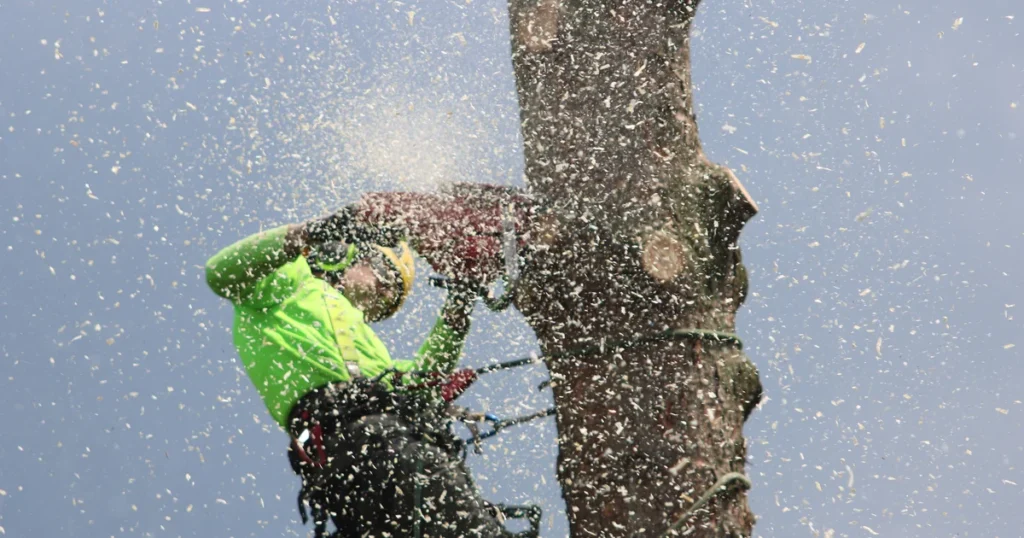
A tree care foreman runs the day-to-day work of a crew on a job site, and that starts with directing people in real time. The foreman assigns tasks to climbers, ground crew, and equipment operators based on what the job calls for that day. Assignments shift as conditions change: a tree turns out to be more hazardous than expected, or a client asks for something different once work is underway.
Before cutting starts, the foreman typically walks the property with the consulting arborist to confirm which trees come down, which limbs get trimmed, and where debris needs to be staged. This walkthrough happens on the property itself, because it depends on seeing the specific trees, the slope of the yard, nearby structures, and power lines.
Safety enforcement is a constant, hands-on part of the job. Foremen are responsible for making sure the crew wears the right personal protective equipment and follows ANSI Z133 safety standards, the industry standard for tree care operations. That standard covers everything from chainsaw handling to electrical hazard distance. Enforcing it only works if the foreman is physically present to see what the crew is doing.
The foreman also manages equipment and materials on site: chainsaws, chippers, bucket trucks, rigging gear, and the wood and brush the job generates. They serve as the client’s main point of contact for the day, answering questions and handling any changes to the scope of work face to face. In most shops, the foreman also climbs trees personally, demonstrating technique to less experienced crew members. They oversee cleanup once the cutting is done, so the property is left in good shape.
Every one of these duties depends on being physically present at a specific location. That’s the root of why this job and remote work don’t combine.
Why “Remote” Rarely Applies to This Job
A tree care foreman cannot direct a crew, enforce safety rules, or operate equipment from a laptop. The foreman has to be physically present for the core duties of the job. That includes walking a job site with an arborist, assigning tasks based on what a tree looks like, and catching an unsafe rigging setup before it causes an injury. There’s no version of this job where those tasks move to a video call.
Tree care employers aren’t unusual in making this tradeoff. The same limitation shows up across skilled-trades supervision generally: a construction site foreman, a warehouse shift supervisor, and a restaurant kitchen manager all run into it too. Supervisory roles built around directing people and equipment in a physical space don’t have a remote equivalent, because the supervision itself requires presence. Tree care foreman jobs fall into that same category.
Watch Out for Mislabeled Listings
Some job boards tag tree care foreman postings as “remote” when the employer’s own job description says otherwise. That mismatch can cost you time if you don’t catch it.
Two specific postings show this clearly. Almstead Tree and Shrub Care posted a “Climber, Tree Crew Foreman” role in Stamford, Connecticut, paying $32 to $40 an hour. One aggregator site tagged this listing as remote. But Almstead’s own job description describes an on-site crew position: climbing and directing work at client properties in the area. There’s no remote component at all.
The Urban Foresters had a similar mismatch. Their posting for a foreman role in Stafford, Texas, paying $22 to $35 an hour, is built around bilingual communication with crew members and clients on site. The employer’s own listing describes on-site work, yet a job board had tagged it remote.
In both cases, the aggregator’s tag was wrong, not the employer’s description. If you see a tree care foreman posting labeled “remote,” go to the employer’s own careers page and read their version of the listing before you trust the tag. Aggregator sites pull and categorize postings automatically. For a physical, on-site trade like this one, that process can mislabel a listing in ways that cost you time if you don’t double-check.
The Closest Real Equivalent: Traveling and Area Foreman Roles
Maybe you’re drawn to “remote” because you want variety, not because you want to work from home. If that’s the appeal, traveling and area foreman roles are the closest match available. These positions exist mainly at utility vegetation-management companies, where crews clear trees and brush away from power lines across a multi-site territory instead of working one property at a time. The foreman still shows up to a physical job site every day; it’s just a different site depending on the week. Some of these roles involve overnight travel, especially during storm restoration work.
Several verified postings illustrate what this looks like in practice. Here is what each of these five companies actually does:
- Nelson Tree Service handles distribution and transmission right-of-way vegetation management and 24/7 storm response for electric utilities, co-ops, and municipalities.
- Wright Tree Service is an employee-owned vegetation management contractor headquartered in West Des Moines, Iowa, founded in 1933 and employee-owned since 2002, with more than 4,000 employees across 16 geographic divisions handling line clearance, right-of-way mowing, and storm restoration.
- Asplundh is a family-owned utility vegetation management company founded in 1928, the first firm to specialize in line clearance rather than residential tree work. It now employs roughly 36,000 people across the US, Canada, Australia, and New Zealand.
- ArborWorks is a California-based vegetation management and wildfire mitigation contractor headquartered in Oakhurst. It has served as PG&E’s prime utility vegetation contractor for the Yosemite Division since 2019 and has been expanding into the southeastern US.
- Davey Tree is a tree care and vegetation management company founded in 1880 and employee-owned since 1979, with more than 12,000 employees across North America and over $1.6 billion in annual revenue.
| Company | Location | Pay | Travel Note |
|---|---|---|---|
| Nelson Tree Service | Lounsberry, NY | Not listed | Posting title explicitly states “Traveling Crews/Overnight Travel Required” |
| Nelson Tree Service | Sheboygan, WI | $36.39-$40.25/hr | Potential out-of-state storm work |
| Wright Tree Service | Stillwater, MN | ~$82,000/yr | “General Foreperson – Travel Pod” role built around mobile crew structure |
| Asplundh | Salem, OR | Not listed | Travel “from job site to job site… with occasional overnight stays at regional sites” |
| ArborWorks | Prescott Valley, AZ | Not listed | “Travel to various job sites may be required” |
| Davey Tree | Oklahoma City, OK | Not listed | Regional travel coverage across TX, AR, MN, and WI |
None of these are remote jobs. The foreman is on site every working day, operating equipment and directing a crew in person. What changes is the location: instead of one job, one address, one client, the foreman covers a territory and moves between sites as the work schedule requires. For someone who wants to avoid being stuck in one spot, that’s a meaningful alternative to chase, even though it isn’t remote work in any sense of the word.
What It Pays
The most reliable wage data for this type of role comes from the Bureau of Labor Statistics’ Occupational Employment and Wage Statistics program. It uses SOC code 37-1012, First-Line Supervisors of Landscaping, Lawn Service, and Groundskeeping Workers, the closest matching government job classification for a tree care foreman. The May 2023 BLS data is the most recent year confirmed available. It’s also the most authoritative figure here, because BLS publishes a documented survey methodology behind it, unlike most job-board salary estimates.
That data shows a national employment count of 126,020 people in this classification, a mean hourly wage of $28.33, and a mean annual wage of $58,920. The median wage was $26.80 an hour, or $55,740 a year. Here’s the full percentile breakdown:
| Percentile | Hourly Wage | Annual Wage |
|---|---|---|
| 10th percentile | $18.76 | ~$39,020 |
| Median (50th) | $26.80 | $55,740 |
| Mean (average) | $28.33 | $58,920 |
| 90th percentile | $39.85 | ~$82,890 |
ZipRecruiter also publishes foreman-specific figures for tree care roles, generally landing in the $23 to $33 an hour range. ZipRecruiter doesn’t publish the methodology behind how it calculates these estimates, so treat that range as a rough market signal rather than an authoritative figure. The individual postings cited earlier in this article range from $22 an hour at The Urban Foresters to roughly $82,000 a year at Wright Tree Service. That spread shows how much pay varies by employer, region, and whether the role involves CDL-required travel.
Qualifications Employers Actually Ask For
Postings for this role tend to ask for at least two years of experience as a foreman or crew leader. Some list three to five or more years of general tree care, climbing, or trimming experience as an alternative path in. An ISA Certified Arborist credential shows up commonly in these postings, usually listed as preferred rather than strictly required.
A commercial driver’s license (CDL) is often preferred or required, especially at utility line-clearance employers where the foreman needs to move bucket trucks and chip trucks between sites. Beyond that, employers want hands-on knowledge of ANSI Z133 safety standards and solid climbing technique using SRT (single rope technique) or DdRT (double rope technique) systems. Rigging experience and the ability to operate chainsaws, chippers, stump grinders, and aerial lifts round out the list.
Where to Actually Search
The TCIA Career Center, run by the Tree Care Industry Association, is the strongest industry-specific option. It lists openings for tree care roles, including line-clearance general foreman positions posted by employers like Davey Tree, and it’s built specifically around this trade.
The ISA Career Center, maintained by the International Society of Arboriculture, is a solid second option for arborist and tree care supervisory roles.
Beyond those two, general job boards like ZipRecruiter, Indeed, and LinkedIn are realistic fallback channels, since there isn’t one single dedicated platform that covers every tree care foreman opening. Whichever board you use, go back to the employer’s own careers page before you trust a listing’s remote or on-site tag. That tag isn’t always accurate for this job title, as the Almstead and Urban Foresters examples show. Because openings for this title are scattered across several boards rather than concentrated on one, a job search spreadsheet can help you track which employer and board each application came from.
A Quick Checklist Before You Apply
- Confirm the role is on-site, traveling, or area-based, not remote, directly on the employer’s own careers page.
- If a job board tags a tree care foreman posting “remote,” treat that as a flag to verify rather than take at face value.
- Check whether the role requires overnight travel, since several traveling foreman positions involve storm restoration work away from home.
- Confirm CDL requirements early if you’re applying to utility line-clearance employers, since it’s a common hard requirement there.
- Compare the posted pay rate against the BLS percentile table above to judge where it falls relative to the national range.
- Ask whether ISA Certified Arborist status is required or just preferred before assuming you’re not qualified.
Common Questions About Remote Tree Foreman Jobs
Does remote tree care foreman work exist? Essentially no. The role requires directing a crew, climbing, and enforcing safety rules on a physical job site, so there’s no version of the job that works remotely. No employer currently advertises a fully remote version of this role.
Why do some job boards list these jobs as remote? Two confirmed cases, Almstead Tree and Shrub Care and The Urban Foresters, show aggregator sites tagging on-site foreman postings as remote despite the employer’s job description saying otherwise. Always check the employer’s listing directly before trusting a board’s tag.
What’s the closest alternative to a remote tree foreman job? Traveling or area foreman roles at utility vegetation-management companies like Nelson Tree Service, Wright Tree Service, Asplundh, ArborWorks, and Davey Tree. These foremen cover a multi-site territory instead of one fixed job, sometimes with overnight travel, but the work is always on-site.
What does a tree care foreman get paid? BLS data for the closest matching classification (SOC 37-1012, May 2023) shows a median wage of $26.80 an hour, or $55,740 a year. The range runs from $18.76 at the 10th percentile up to $39.85 at the 90th percentile. Individual postings referenced in this article range from $22 an hour up to roughly $82,000 a year depending on the employer and whether travel is required.
What do I need to qualify for a foreman role? Most postings ask for two or more years as a foreman or crew leader, or three to five-plus years of general tree care experience. An ISA Certified Arborist credential and a CDL are commonly preferred, and employers expect solid climbing, rigging, and equipment operation skills along with ANSI Z133 safety knowledge.
The Bottom Line on Remote Tree Foreman Jobs
Tree care foreman jobs are built around physical presence: directing a crew, climbing, enforcing safety standards, and serving as the on-site point of contact for a client. None of that converts to remote work. The handful of “remote” listings on job boards for this title turned out to be mislabeling errors, not a hidden category of jobs waiting to be discovered.
If flexibility is what drew you to the word “remote” in the first place, traveling and area foreman roles at utility vegetation-management companies are the closer match. That means different job sites, sometimes different states, but always on-site work. Start your search at the TCIA Career Center or the ISA Career Center, and double-check any listing’s location tag against the employer’s own careers page before you apply. Once you land an interview, the usual advice for reading how it went still applies; our guide to signs you’ll get the job after an interview covers what to watch for.
About the author: Jason Write writes and researches career guides for Remote Online Evaluator, an independent publication focused on honest, no-hype coverage of job search and remote work topics. Read more about the site’s editorial approach and mission, or get in touch with questions or corrections.