
If you’re exploring how to start a career in digital evaluation, understanding remote evaluator training is the first step. Today’s online platforms, AI-driven workflows, and global testing environments require evaluators to be more skilled, more adaptable, and far more data-aware than ever before. Whether someone wants to evaluate search engines, ads, AI responses, content relevance, or user intent accuracy, their success depends heavily on the quality of training and certification they pursue. This guide breaks down what the training involves, who provides it, and how beginners and experienced workers can choose the right learning path.
The modern evaluator role has expanded beyond simple rating tasks. Companies now expect professionals who can analyse behavioural data, apply detailed guidelines, understand quality metrics, and make consistent, unbiased decisions. Because the demand for accuracy continues to increase—especially with the rise of generative AI—specialised training programs now teach critical thinking, task calibration, annotation standards, and model evaluation workflows. This overview helps readers compare certification options, understand skill requirements, and confidently choose the training path that aligns with their long-term goals.
What Is a Remote Online Evaluator and What Do They Do?
A remote online evaluator reviews and rates digital content to help improve algorithms, AI systems, search results, and user experience. Their work directly influences how platforms deliver accurate, safe, and relevant information.
Key responsibilities include:
- Scoring search results for relevance
- Evaluating AI model responses for accuracy and safety
- Rating ads for quality and targeting
- Analysing content for policy compliance
- Performing data annotation and categorisation
- Detecting bias, misinformation, or harmful patterns
- Reviewing usability of websites and app flows
Modern evaluators play a critical role in training and refining machine-learning models, making their job essential in 2025’s AI-powered digital ecosystem.
Why Training Matters: The New Skill Expectations in 2025
Training has become more crucial than ever because companies now expect evaluators to handle:
- More complex AI-generated outputs
- Longer and stricter rating guidelines
- Higher accuracy requirements
- Faster decision-making under calibration
- Bias awareness and ethical judgement
A trained evaluator performs better, passes qualification exams faster, and earns more consistent work from platforms.
Types of Evaluator Certifications
| Certification Type | Best For | Skills Covered | Difficulty Level |
|---|---|---|---|
| Search Quality Evaluation | Beginners | Relevance testing, user intent analysis | Medium |
| AI Model Evaluation | Intermediate | LLM scoring, response accuracy, safety checks | High |
| Data Annotation Training | Beginners to Intermediate | Tagging, labelling, classification | Low–Medium |
| UX & Web Testing Certification | Professionals | Usability testing, task flows, heuristics | High |
How Does Remote Evaluator Training Work?
Training is usually delivered through a mix of modules, quizzes, examples, calibration tasks, and real-world rating simulations.
1. Guideline Learning
Every evaluation job is based on a guideline document—sometimes up to 200+ pages. Training teaches you how to:
- Interpret user intent
- Understand query complexity
- Apply rating scales
- Evaluate context and meaning
- Follow policies consistently
2. Calibration Exercises
These are sample tasks where your answers are compared with “gold standard” responses from experts. Calibration ensures:
- You understand the guidelines
- You apply scoring accurately
- You match the platform’s decision logic
3. Skill Assessments
Many companies require qualification exams before giving real work. Training prepares you for:
- Multiple-choice guideline tests
- Practical evaluation tasks
- Scenario-based problem-solving
4. Continuous Quality Monitoring
Once hired, evaluators undergo:
- Spot checks
- Accuracy scoring
- Weekly performance reviews
Training ensures you stay consistent and avoid task rejections.
Training Providers at a Glance
| Provider | Known For | Format | Cost |
|---|---|---|---|
| Appen | Search evaluation tasks | Self-paced | Free/Low |
| TELUS International | Contributor training | Guided modules | Free |
| OpenAI Contractors | AI model evaluation | Invitation-based | Free |
| Coursera/edX | Professional certifications | Video + quizzes | Paid |
| Udemy | Short evaluation courses | On-demand | Low |
Which Certifications Matter the Most in 2025?
While the industry has many training paths, the most valuable ones align with the jobs in highest demand.
1. Search Engine Evaluation Certification
Ideal for beginners, this teaches:
- Query intent interpretation
- Relevance and helpfulness scoring
- Localisation and cultural understanding
- Content quality analysis
Companies hiring: TELUS, Appen, OneForma
2. AI Model Evaluation Certification
The fastest-growing field, covering:
- Large Language Model (LLM) scoring
- Factuality checks
- Safety and bias detection
- Structured rubric-based evaluation
Companies hiring: OpenAI contractors, Scale AI, DataAnnotationTech
3. Data Annotation Certification
A flexible path useful for general digital work:
- Image, audio, text, and video labelling
- Categorisation and clustering
- Bounding boxes, criteria tagging
- Metadata creation
Platforms hiring: Remotasks, Clickworker, Toloka
4. UX & Website Testing Certification
Advanced option for higher-paying tasks:
- Usability heuristics
- Navigation and flow testing
- Conversion behaviour tracking
- Accessibility checks
Essential Skills You Learn in Evaluator Programs
| Skill Area | Why It Matters | Real-World Use Case |
|---|---|---|
| Guideline Comprehension | Ensures accuracy & consistency | Rating search results |
| Analytical Thinking | Helps identify patterns & errors | Evaluating AI model outputs |
| Content Quality Scoring | Measures relevance & safety | Checking ads or content |
| Data Annotation | Improves dataset quality | Tagging images, audio, text |
| Ethical & Bias Awareness | Prevents skewed results | Fairness checks in AI |
How Long Does Training Take?
Training duration varies depending on complexity:
- Search evaluation: 5–10 hours
- AI model evaluation: 10–20+ hours
- Annotation training: 2–6 hours
- UX testing: 10–25 hours
Some certifications include ongoing updates as guidelines evolve.
How Much Does Training Cost?
Most official evaluator platform training is:
- Free, if you’re hired (Appen, TELUS, OpenAI contractors)
- Low-cost, on independent course platforms
- Paid, for advanced certifications (Coursera, UX training providers)
Is Certification Required to Get Hired?
Not always — but it increases your chances significantly.
Companies often prefer:
- Candidates who already understand evaluation fundamentals
- Workers who can pass tests on the first try
- People with consistent scoring accuracy
Certification also reduces training time for employers, making certified candidates more attractive.
Step-by-Step: How to Choose the Right Evaluator Training
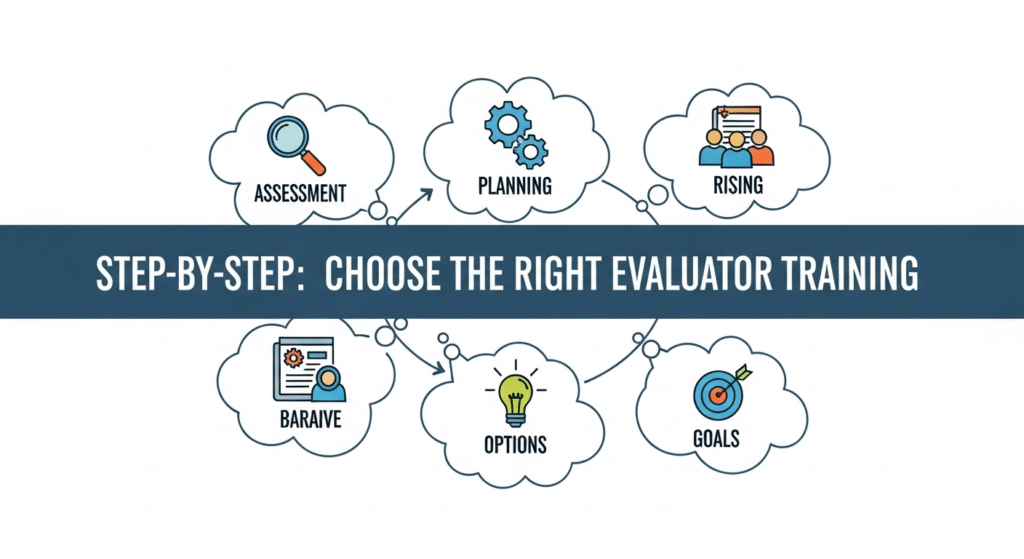
Step 1: Identify your target role
Ask yourself:
- Do I want AI model evaluation?
- Do I want simpler search rating tasks?
- Do I prefer annotation or categorising?
- Do I want long-term, consistent work?
Step 2: Review skill requirements
Different roles demand different abilities. Choose training that matches your strengths.
Step 3: Compare training formats
Options include:
- Self-paced modules
- Instructor-led courses
- Bootcamp-style programs
- Company-provided training
Step 4: Check credibility
Choose courses created by:
- Industry experts
- Former evaluators
- AI researchers
- UX professionals
Step 5: Evaluate job outcomes
Ask:
- Does this certification help me qualify for real roles?
- Has the training provider worked with major companies?
What Skills Make a Successful Evaluator in 2025?

Here are the core traits top evaluators share:
1. Attention to Detail
Rating accuracy determines work volume and contract stability.
2. Strong Reading Comprehension
You’ll work through complex guidelines and policies.
3. Analytical Thinking
Critical judgement is essential for evaluating AI outputs.
4. Cultural Knowledge
Helps interpret queries, trends, slang, and local behaviour.
5. Ethical Decision-Making
AI safety and fairness depend on unbiased evaluators.
Common Challenges Beginners Face (and How Training Fixes Them)
Challenge 1: Understanding Long Guidelines
Solution: Structured training breaks guidelines into digestible modules.
Challenge 2: Passing Qualification Exams
Solution: Practice tests and calibration improve scoring accuracy.
Challenge 3: Inconsistent Ratings
Solution: Training teaches how to anchor decisions to rubric examples.
Challenge 4: Slow Task Speed
Solution: Repetition improves workflow efficiency.
Challenge 5: Dealing With Subjective Judgements
Solution: Training provides examples and clarifies uncertainty.
How to Stay Updated After Certification
Because guidelines change frequently, you should:
- Revisit training modules
- Join evaluator communities
- Update your understanding of AI safety policies
- Practice with sample tasks
- Follow industry experts on AI quality
Professionals who stay updated perform better and maintain long-term contracts.
Future Trends in Evaluator Training
In the next few years, expect to see:
1. AI-Assisted Training Tools
Simulated evaluation tasks with AI feedback.
2. Micro-Certifications
Shorter badges for specific evaluator skills.
3. Higher Standards for AI Safety
More training around misinformation, bias, and hallucination checks.
4. Expansion of Multilingual Evaluation
More roles for bilingual and bicultural evaluators.
5. Integration with Data Ops Careers
Evaluation becomes a gateway to roles in:
- AI safety
- Data quality
- Machine learning operations
Conclusion
Choosing the right training pathway is essential for building a strong and sustainable career in the evaluation industry, and this is where remote evaluator training becomes a powerful advantage. With structured training, you learn how to interpret complex guidelines, improve your scoring accuracy, and pass qualification exams with confidence. It also helps you stay consistent when evaluating AI outputs, search relevance, ads, and other digital content. Whether you’re just getting started or upgrading your expertise, proper training ensures you meet the higher standards companies expect in 2025.
As AI continues shaping the digital world, organisations rely heavily on trained evaluators to maintain safety, fairness, and high-quality user experiences. This means professionals who invest in strong training open the door to better roles, long-term contracts, and more reliable income. Use this guide as your step-by-step roadmap to compare certifications, choose the right provider, and prepare for the most in-demand evaluator opportunities. With the right preparation and mindset, you can build a future-proof career in one of the fastest-growing remote job fields.
FAQs
1. What is remote evaluator training?
Remote evaluator training is a structured learning program that teaches you how to rate search results, evaluate AI responses, analyse content quality, and follow detailed guidelines. It prepares you for qualification exams and improves your accuracy when working on real tasks.
2. Do I need certification to become an online evaluator?
Certification isn’t always required, but it increases your chances of getting hired. It shows employers that you understand evaluation guidelines, can apply scoring rules correctly, and are ready for advanced tasks from day one.
3. How long does remote evaluator training take?
Training time varies by program, but most courses take between 5 and 20 hours. Search evaluation is shorter, while AI model evaluation and UX-related certifications take longer because they require deeper analysis.
4. Which certification is best for beginners?
Beginners usually start with search quality evaluation or data annotation certification. These programs teach the basics of relevance scoring, content analysis, and guideline reading—making them ideal for new evaluators.
5. Who provides the best remote evaluator training programs?
Top options include TELUS International, Appen, OpenAI contractor programs, Coursera, edX, and Udemy. Some offer free platform training, while others provide structured, paid professional certifications.
6. Can I work as an evaluator without previous experience?
Yes. Most companies hire beginners as long as they can follow instructions, write clearly, and pass qualification exams. Completing remote evaluator training gives you a stronger advantage and improves your approval chances.
7. What skills do I need to succeed as an online evaluator?
You’ll need attention to detail, reading comprehension, critical thinking, and cultural awareness. Training programs help you build these skills and apply them consistently in real evaluation tasks.
8. Is remote online evaluator work safe and legit?
The role is safe and legitimate when you work with trusted companies like TELUS, Appen, DataAnnotationTech, and OneForma. Always avoid platforms asking for upfront fees or personal bank information.
9. How much can I earn after completing training?
Earnings depend on project type and location. Most remote evaluators make between $8 and $20 per hour, while specialised AI evaluation projects pay more. Certification can increase your earning potential.
10. Does training guarantee a job?
No certification guarantees a job, but completing remote evaluator training significantly improves your chances. It helps you pass qualification exams faster and makes you more competitive for high-demand roles.