
In 2026, the role of a remote online evaluator has become one of the most in-demand and flexible online jobs worldwide. These professionals work from home to help major tech companies like Google, Appen, and TELUS International improve the quality of online search results, ads, and digital content. By analyzing user intent, reviewing web pages, and rating relevance, online evaluators ensure that what people see on search engines is accurate, helpful, and safe. This job doesn’t require a degree, making it an ideal opportunity for students, freelancers, and professionals who want flexible, remote work that actually pays.
A remote online evaluator career offers freedom, stability, and purpose in the growing digital economy. Whether you’re a student looking for part-time income or a professional seeking a side hustle, this role helps you contribute to the internet’s accuracy while earning from anywhere in the world. It’s a genuine, non-technical online job that combines analytical thinking with independent work all while giving you control over your schedule and workload. In this guide, we’ll explore how to get started, what skills you need, and how to grow your career as a trusted remote online evaluator.
What Is a Remote Online Evaluator Job?
A remote online evaluator is a professional who helps search engines and AI systems deliver better, more accurate results. In this role, you review web pages, ads, videos, or images and assess their quality and relevance to user queries.
For example:
If someone searches “best coffee shops near me,” your task might be to evaluate whether the results shown truly match that intent — or if they need improvement.
Companies like TELUS International, Appen, RaterLabs, and OneForma hire online evaluators globally to refine the algorithms behind Google, Bing, and social platforms.
This job is ideal for anyone who wants to work from home, manage their own schedule, and contribute to how billions of people find information online.
Why Remote Online Evaluator Jobs Are Growing in 2026
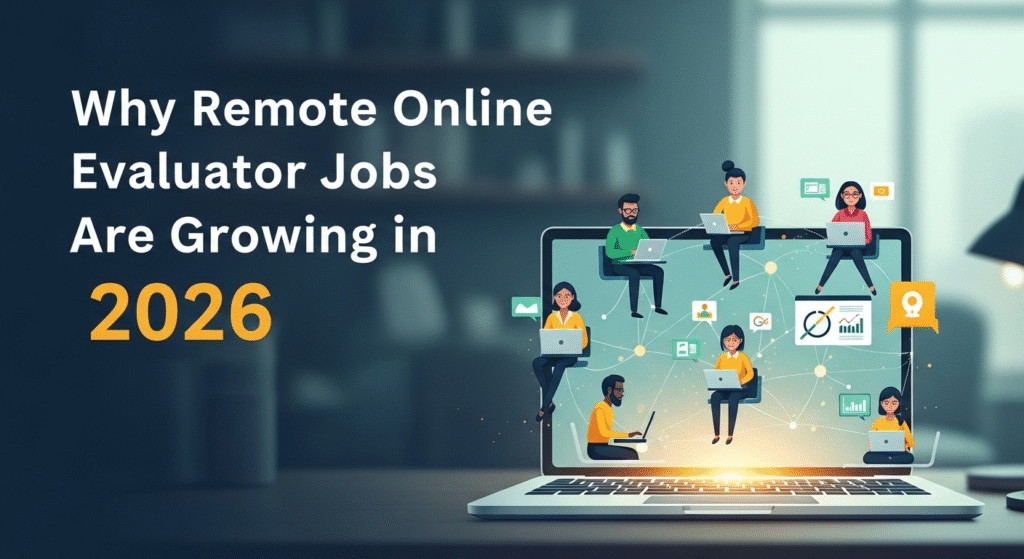
The demand for online evaluators is rising fast and for good reason. As AI-powered search becomes smarter, companies still rely on real humans to provide context, cultural understanding, and unbiased feedback.
Key Reasons for Growth
- AI expansion: Human reviewers are needed to train and validate AI models.
- Search quality improvement: Search engines need accurate feedback to reduce misinformation.
- Remote-first work culture: More companies are hiring flexible, global talent.
- Low entry barrier: No degree or technical background required just strong judgment and language skills.
Industry data suggests that AI data evaluation jobs will grow by 40% through 2026, creating thousands of new opportunities for remote workers.
What Does a Remote Online Evaluator Do Daily?
Your day-to-day work as a remote online evaluator depends on the project type. However, most tasks focus on reviewing online data and improving quality.
Common Responsibilities
- Evaluate search results for accuracy and relevance.
- Rate advertisements based on clarity and usefulness.
- Assess web pages for quality, readability, and authority.
- Review videos, maps, or app content for compliance with standards.
- Provide feedback using company-specific rating guidelines.
Each task usually includes detailed instructions, and your accuracy is measured by quality scores the higher you score, the more projects you qualify for.
How Does a Remote Online Evaluator Improve Search Results?
A remote online evaluator helps bridge the gap between artificial intelligence and human behavior.
Search engines like Google use algorithms to rank results, but these algorithms can’t always interpret intent or cultural nuance. That’s where evaluators step in.
You analyze real search queries and decide whether the top results make sense. If not, your feedback guides engineers and AI trainers to refine how future searches are ranked.
In short: evaluators teach search engines to think more like humans.
Skills You Need to Succeed as a Remote Online Evaluator

You don’t need a degree but you do need strong soft skills, critical thinking, and consistency.
Core Skills
- Analytical thinking: Understand what makes search results useful.
- Strong written communication: Clearly describe why content is relevant or misleading.
- Cultural awareness: Recognize local trends, slang, and behaviors in your language region.
- Time management: Work independently and meet task deadlines.
- Basic computer literacy: Comfort using web browsers, search engines, and spreadsheets.
Bonus Skills That Give You an Edge
- Familiarity with digital marketing or SEO basics.
- Ability to work with multiple browser tabs and multitask efficiently.
- Understanding of online content evaluation metrics like E-E-A-T (Experience, Expertise, Authoritativeness, Trustworthiness).
How to Become a Remote Online Evaluator
You can start this career with minimal setup all you need is an internet connection and strong attention to detail.
Step 1: Find Legitimate Companies Hiring Evaluators
Apply only through verified organizations. Some of the most trusted include:
- TELUS International AI
- Appen
- RaterLabs (Leapforce)
- OneForma
- Remotasks
These platforms regularly hire part-time evaluators for global projects.
Step 2: Submit an Application
Provide your:
- Basic information (name, country, email)
- Resume or LinkedIn profile
- Language proficiency
- Availability (part-time/full-time)
Most companies require a short qualification test to assess your ability to follow search quality guidelines.
Step 3: Pass the Qualification Exam
Before starting paid work, you’ll study training materials about:
- User intent
- Content relevance
- Rating accuracy
Passing the test qualifies you to join live projects.
Step 4: Start Working and Logging Tasks
Once onboarded, you’ll access a task dashboard showing assignments. You can pick tasks that fit your schedule — typically ranging from 5 to 25 hours per week.
What Is the Salary of a Remote Online Evaluator?
Earnings depend on the company, project type, and location.
Here’s a general range based on 2025 rates:
- Beginners: $8–$12 per hour
- Experienced evaluators: $15–$25 per hour
- Specialized evaluators (ads or social media): $25–$30 per hour
Some evaluators work part-time for extra income, while others treat it as a full-time remote job.
Many professionals earn around $500–$1,000 per month working 10–20 hours weekly.
Benefits of Working as a Remote Online Evaluator
This role offers a combination of flexibility, learning, and impact that few online jobs match.
Top Benefits
- Work from anywhere: Perfect for digital nomads, students, or stay-at-home parents.
- Set your own hours: Choose when to log in and complete tasks.
- No degree required: Skill-based, not qualification-based.
- Global opportunities: Available in multiple languages and regions.
- Skill growth: Improves your analytical, linguistic, and digital research abilities.
You also gain firsthand experience with how search engines and AI learn a valuable insight for future roles in data annotation or digital marketing.
Is a Remote Online Evaluator Job Legit or a Scam?
The role itself is completely legitimate, but like many online jobs, there are fake listings that exploit job seekers.
How to Identify Legit Opportunities
Only apply on official company websites (Appen, TELUS International, etc.).
Avoid listings on social media or unknown job portals that ask for payment or “activation fees.”
Check Glassdoor reviews or Reddit discussions for company reputation.
Never share personal banking information until after official onboarding.
Real evaluator companies pay you via PayPal, Payoneer, or direct deposit, not through crypto or gift cards.
Who Should Apply for a Remote Online Evaluator Job?
This flexible job fits a wide range of people, especially those who value independence and mental focus.
Ideal Candidates
- Students: Work part-time while studying.
- Freelancers: Earn steady income between projects.
- Professionals: Supplement income with a flexible side job.
- Parents or caregivers: Balance home responsibilities with remote work.
Anyone fluent in English (or other target languages) and comfortable navigating the web can apply.
Tools and Requirements for the Job
You don’t need advanced tools just reliable basics.
Must-Have Requirements
- A laptop or computer (no mobile-only work).
- Stable internet connection (minimum 10 Mbps).
- Google Chrome or Firefox browser.
- Email account for communication.
- Quiet workspace to focus on tasks.
Optional Tools to Improve Efficiency
- Grammarly for writing clarity.
- Google Sheets for task tracking.
- VPN (if your project requires region-specific testing).
Challenges You Might Face
Every flexible job comes with tradeoffs.
Common Challenges
- Inconsistent workload: Some weeks have fewer tasks available.
- Repetitive tasks: Evaluation can get routine over time.
- Strict accuracy guidelines: Errors can affect your quality score.
- Limited interaction: Mostly solo work without a team environment.
How to Overcome Them
- Register with multiple platforms to increase task availability.
- Set daily or weekly goals to stay productive.
- Take breaks between tasks to maintain focus.
- Join evaluator forums for support and community discussions.
Tips to Succeed as a Remote Online Evaluator
Want to stand out and earn consistently? Follow these expert-backed tips:
- Follow guidelines exactly — accuracy is everything.
- Start slow to understand patterns before speeding up.
- Aim for high-quality scores (90%+ means more projects).
- Stay updated — AI and rating systems evolve often.
- Track your time to identify your most productive hours.
High-performing evaluators often receive priority access to premium or long-term projects.
The Future of Remote Online Evaluation
The future of this role is promising as AI integration grows across industries.
Search engines, chatbots, and recommendation systems all rely on human evaluators to train their algorithms. Experts predict a 45% increase in demand for roles involving data quality and AI model evaluation by 2026.
For many, this job is also a gateway into tech and data careers helping them transition later into fields like:
- AI data annotation
- Content moderation
- SEO analysis
- UX research
In short, it’s not just a part-time job it’s a stepping stone into the digital future.
Conclusion
Building a career as a remote online evaluator is one of the smartest ways to enter the digital workforce without needing technical expertise or heavy investment. It’s a legitimate, flexible job that allows you to work from anywhere, sharpen your analytical thinking, and contribute to improving how billions of people experience online content every day. Whether you’re rating ads, reviewing search results, or testing web pages, your work directly impacts the quality and accuracy of global search engines.
As the demand for online evaluation continues to rise in 2026 and beyond, now is the best time to explore this opportunity. If you value independence, flexible hours, and meaningful online work, becoming a remote online evaluator can be your gateway to a reliable and rewarding online career. Start small, keep learning, and you’ll soon build the experience that makes you stand out in this growing digital field.
FAQs
1. What does a remote online evaluator do?
A remote online evaluator reviews and rates search results, advertisements, and online content to help improve their accuracy and quality. The goal is to make sure users find relevant and useful information when they search online. Evaluators analyze queries, judge the intent behind searches, and rate the results based on detailed guidelines provided by companies like Google, Appen, or TELUS International.
2. Do I need a degree to become a remote online evaluator?
No, you don’t need a degree or prior experience to start. Most companies only require strong English skills, internet literacy, and attention to detail. However, having a background in linguistics, marketing, or communications can be a plus when applying for higher-paying evaluation projects.
3. How much can I earn as a remote online evaluator?
Earnings vary by company and project, but most evaluators earn between $10 to $25 per hour depending on their experience and region. Some long-term projects may pay more, especially if you specialize in ad evaluation or search quality analysis.
4. Which companies hire remote online evaluators?
Top companies hiring remote online evaluators include Appen, TELUS International, RaterLabs, Google (through partners), and OneForma. These organizations regularly post legitimate work-from-home evaluation jobs that allow you to work independently and set your own schedule.
5. Is remote online evaluator work legit or a scam?
Yes, it’s completely legitimate as long as you apply through trusted companies. Be cautious of fake job listings that ask for money or personal banking details. Real evaluator jobs never require payment to apply or start working.
6. What skills are required to become a successful remote online evaluator?
You’ll need critical thinking, language proficiency, research skills, and the ability to follow detailed instructions. Being consistent, objective, and analytical will help you perform better and qualify for higher-level projects over time.
7. Can students or part-time workers apply for remote online evaluator jobs?
Absolutely. These jobs are perfect for students, freelancers, or professionals looking for part-time or flexible work-from-home opportunities. You can choose projects based on your availability, making it a great side income option.
8. How can I start working as a remote online evaluator in 2026?
Start by signing up with trusted platforms like Appen, TELUS International, or OneForma. Complete their qualification tests, review the project guidelines carefully, and once approved, you can begin working from home on real evaluation tasks.
9. What kind of equipment do I need for this job?
You’ll only need a computer or laptop, a stable internet connection, and sometimes a mobile device for app-related tasks. Good communication tools like Gmail and Slack are also helpful for staying updated on assignments.
10. Is remote online evaluator work a long-term career option?
Yes, it can be especially if you’re consistent and build experience across multiple projects. Some evaluators grow into full-time quality analysts, AI trainers, or data evaluators for tech companies. It’s an excellent way to start a long-term remote career in the digital world.