

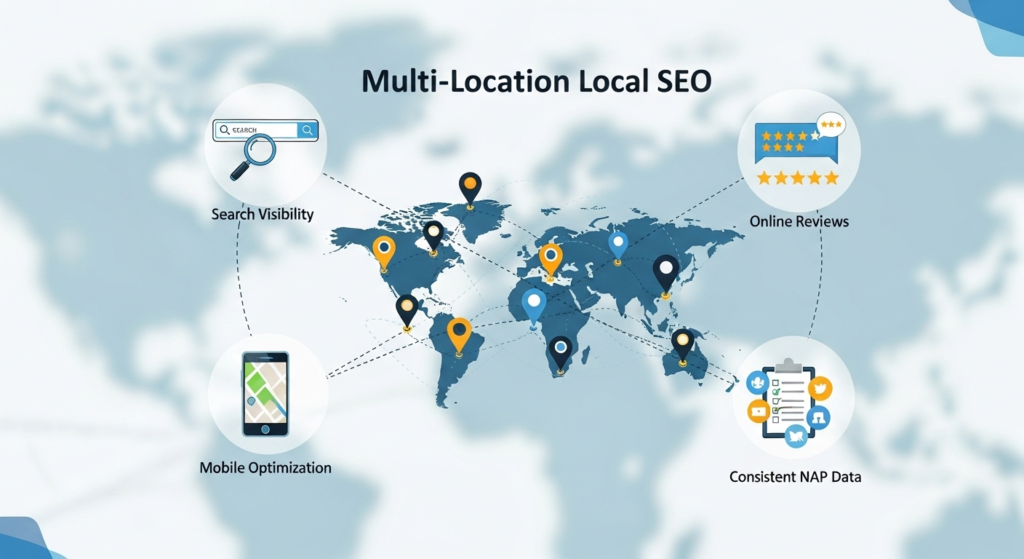
Remote Local SEO for Multi Location Businesses is a digital marketing strategy that allows companies with multiple physical locations to optimize their local search presence across different markets from a central location. This approach combines creating separate Google Business Profiles for each location, building unique location specific landing pages, maintaining consistent NAP (Name, Address, Phone) citations, and managing customer reviews at scale all without requiring on site staff at every location.
The strategy helps franchises, retail chains, and service businesses rank in local search results and Google’s local pack (top 3 map listings) for each market they serve. Key tactics include optimizing each location’s Google Business Profile with local content and photos, implementing proper schema markup for multi location structure, building local citations across directories, and tracking performance metrics like local rankings, direction requests, and phone calls to continuously improve visibility and drive more customers to each location.
Understanding Remote Local SEO for Multiple Locations
Remote local SEO refers to the practice of optimizing your online presence for local search results across multiple geographic locations without physically being present at each site. This approach combines traditional SEO principles with location specific optimization techniques, all managed from a central point.
For multi location businesses, the stakes are particularly high. Each location competes not only with local competitors but also risks competing against your own other locations in search results. The goal is to ensure that when someone searches for your services in any of your operating areas, the most relevant location appears prominently in their search results.
The complexity increases exponentially with each additional location. A business with two locations has a manageable challenge, but one with 50 or 500 locations needs a scalable, systematic approach that can be executed efficiently from anywhere.
For a deeper technical explanation of implementation, see our guide on remote local SEO works many of the foundational principles scale directly to multi location businesses.
Key Components of Multi Location Local SEO
Google Business Profile Optimization
Your Google Business Profile (formerly Google My Business) serves as the cornerstone of your local SEO efforts. For multi-location businesses, this means creating and optimizing a separate profile for each physical location.
Critical elements for each profile include:
- Complete and accurate business information (name, address, phone number)
- Consistent NAP (Name, Address, Phone) data across all platforms
- Location-specific business hours, including holiday schedules
- High-quality photos of each actual location, not stock images
- Detailed service descriptions tailored to local offerings
- Regular posts about location-specific events, offers, and updates
- Active management of customer reviews and questions
The key is maintaining consistency while allowing for location-specific variations. Your brand name should remain constant, but each location needs its unique address and, ideally, a local phone number rather than a call center number.
Website Architecture and Content Strategy
Your website structure plays a crucial role in how search engines understand and rank your multiple locations. The most effective approach is creating dedicated landing pages for each location.
Each location page should contain:
- Unique, locally-relevant content (avoid duplicating content across locations)
- Embedded Google Maps showing the specific location
- Local contact information prominently displayed
- Directions and parking information
- Location-specific testimonials and case studies
- Information about local team members or managers
- Content addressing local market needs and preferences
Beyond individual location pages, your site architecture should make it easy for both users and search engines to find any location. Consider implementing a location finder tool, creating state or region hub pages, and ensuring your main navigation clearly directs users to location information.
Dedicated landing pages per location are essential. This is part of professional remote local SEO services where scalability is built into architecture from day one.
Remote Management Strategies
Managing local SEO for multiple locations remotely requires robust systems and processes. Here’s how successful multi-location businesses approach this challenge:
Centralized vs. Decentralized Management
| Management Approach | Advantages | Disadvantages | Best For |
|---|---|---|---|
| Centralized | Consistent branding, streamlined processes, easier quality control, unified reporting | Less local customization, potential disconnect from local markets, slower response to local issues | Franchises, corporate chains with strict brand guidelines |
| Decentralized | Local market expertise, faster response times, authentic local engagement, location-specific creativity | Inconsistent branding, harder to scale, challenging quality control, fragmented data | Businesses with autonomous local managers, diverse local markets |
| Hybrid | Balance of consistency and flexibility, scalable with local input, best of both approaches | Requires clear guidelines, more complex management structure, needs strong communication | Most multi-location businesses, especially those with 10+ locations |
Most successful multi location businesses adopt a hybrid approach, maintaining central control over brand elements and core SEO strategies while empowering local teams to engage with their communities and create location specific content.
Technology and Tools Stack
Remote management is impossible without the right technology infrastructure. Essential tools for multi-location local SEO include:
Listing Management Platforms:
- Centralized dashboard for managing all Google Business Profiles
- Automated posting across multiple locations
- Bulk upload and update capabilities
- Review monitoring and response management
SEO and Analytics Tools:
- Local rank tracking for each location
- Website traffic analysis by location
- Competitor monitoring across markets
- Performance benchmarking between locations
Content Management:
- Template systems for creating location-specific content
- Digital asset management for photos and videos
- Approval workflows for location-generated content
Communication Tools:
- Project management platforms for coordinating with location managers
- Video conferencing for training and updates
- Shared documentation for guidelines and best practices
Citation Building and Directory Management

Local citations mentions of your business name, address, and phone number on other websites significantly impact local search rankings. For multi-location businesses, citation management becomes exponentially more complex but no less important.
Citation Consistency Across Locations
Every location needs consistent citations across major directories, industry-specific platforms, and local directories. This means:
- Ensuring identical formatting of business name across all citations
- Using the exact address format that appears on your Google Business Profile
- Maintaining consistent phone numbers for each location
- Updating citations whenever location information changes
High priority citation sources include:
- Google Business Profile
- Apple Maps
- Bing Places
- Facebook Business Pages
- Yelp
- Better Business Bureau
- Industry-specific directories (Healthgrades for healthcare, Avvo for legal, etc.)
- Local chamber of commerce websites
- Local news and media sites
For businesses with many locations, manual citation management becomes impractical. Invest in citation management software that can distribute your information across hundreds of directories simultaneously while monitoring for inconsistencies.
Review Management at Scale
Online reviews significantly influence both search rankings and consumer decisions. For multi-location businesses, review management requires a systematic approach that balances efficiency with personalization.
Building a Review Generation System
| Strategy Component | Implementation | Expected Impact |
|---|---|---|
| Automated Review Requests | Email or SMS sent 2-3 days after service/purchase | 3-5x increase in review volume |
| In-Person Requests | Train staff to ask satisfied customers verbally | Higher 5-star review ratio |
| QR Codes | Display at checkout or on receipts | Easy access for mobile users |
| Follow-up Sequences | Multi-touch campaigns for non-responders | 20-30% additional reviews |
| Incentive Programs | Contest entries (not direct payment) for reviews | Sustained review momentum |
Review response protocols should include:
- Response timeframe targets (ideally within 24-48 hours)
- Template responses that can be personalized
- Escalation procedures for negative reviews
- Guidelines for addressing specific issues
- Training for local managers on brand voice
The key is making each response feel personal and location-specific, even when using templates. Mentioning local landmarks, addressing the reviewer by name, and referencing specific details from their review all help create authentic engagement.
Local Content Creation Strategy

Content remains king in SEO, and for multi-location businesses, creating locally-relevant content at scale presents both challenges and opportunities.
Scalable Content Creation Framework
Rather than creating entirely unique content for each location from scratch, develop a scalable framework:
Core Content Templates: Create high-quality template content that addresses common customer needs, then customize with local information:
- Service descriptions with local examples
- FAQ pages with location-specific answers
- Blog post templates that local teams can populate with local events or news
- Video scripts that can be filmed at different locations
Local Content Initiatives:
- Spotlight local team members and their community involvement
- Cover local events your business sponsors or participates in
- Address location-specific regulations or requirements
- Highlight partnerships with local organizations
- Create neighborhood guides relevant to your services
User-Generated Content:
- Encourage and feature customer photos at specific locations
- Share customer success stories from different markets
- Create location-specific hashtags for social media
- Run local contests that generate content
Technical SEO Considerations
The technical foundation of your website directly impacts how well search engines can crawl, understand, and rank your location pages.
Schema Markup for Multiple Locations
Implementing proper schema markup helps search engines understand your multi-location structure:
LocalBusiness schema for each location with:
Correct business type
Complete address information
Geo coordinates
Operating hours
Contact information
Price range
Accepted payment methods
For the organization level, use Organization schema that references all locations, creating a clear hierarchical relationship search engines can understand.
Mobile Optimization
Local searches predominantly occur on mobile devices, making mobile optimization critical:
- Fast loading times (under 3 seconds ideal)
- Responsive design that works on all screen sizes
- Click-to-call functionality for phone numbers
- Easy-to-use location finder with GPS integration
- Simple, clear calls-to-action
- Mobile-friendly forms for appointments or inquiries
URL Structure and Internal Linking
Your URL structure should clearly indicate location hierarchy:
- yourbusiness.com/locations/california/los-angeles/
- yourbusiness.com/locations/texas/dallas/
- yourbusiness.com/locations/new-york/new-york-city/
This structure helps both users and search engines navigate your site while establishing topical relevance for different geographic areas.
Internal linking between location pages and from your homepage to location pages distributes authority and helps search engines discover and index all your locations.
Performance Tracking and Optimization
What gets measured gets managed. For multi location businesses, comprehensive tracking enables data driven decisions and continuous improvement.
Key Performance Indicators by Location
| Metric Category | Specific KPIs | Tracking Frequency | Action Triggers |
|---|---|---|---|
| Visibility | Local pack rankings, organic position for key terms, impression share | Weekly | Drop >3 positions, competitor gains |
| Engagement | GBP views, website clicks, direction requests, phone calls | Daily | 20% decrease week-over-week |
| Conversion | Form submissions, online bookings, store visits (when available) | Daily | Conversion rate drops below benchmark |
| Reputation | Review rating, review volume, review response rate | Daily | Rating drops below 4.0, negative review |
| Technical | Page load time, mobile usability errors, crawl errors | Weekly | Errors affecting >5% of locations |
Regular reporting should compare performance across locations, identifying both best performers (to replicate their strategies) and underperformers (to provide additional support).
For real world examples, explore ourremote local SEO case studies to see how multi location campaigns perform over time.
Competitive Analysis by Market
Local competition varies significantly by market. A location in a small town might have minimal competition, while urban locations could face dozens of competitors. Conduct market-by-market competitive analysis to:
- Identify local competitors for each location
- Analyze their local SEO strategies
- Find content and citation gaps you can fill
- Discover local link-building opportunities
- Understand market-specific search behavior
Common Pitfalls and How to Avoid Them
Duplicate Content Issues: Never copy-paste the same content across location pages. Search engines may ignore duplicate pages, wasting your SEO potential. Even when using templates, ensure each location has unique elements.
Inconsistent NAP Information: A single inconsistency between your website, Google Business Profile, and citations can confuse search engines and hurt rankings. Implement regular audits to catch and correct discrepancies.
Neglecting Underperforming Locations: Some locations will naturally perform better than others, but neglecting struggling locations creates missed opportunities. Use insights from top performers to help underperformers improve.
Over-Automation: While automation enables scale, over-automating can make your content feel robotic and harm user experience. Balance efficiency with authenticity, especially in customer communications.
Building a Sustainable Remote Local SEO Program

Success in remote local SEO for multi location businesses comes from building systems that are both effective and sustainable. This means:
Creating Standard Operating Procedures: Document every process, from setting up new locations to responding to reviews, ensuring consistency and making onboarding new team members easier.
Investing in Training: Whether central team members or local managers handle certain tasks, comprehensive training ensures everyone understands both the how and the why of your local SEO strategy.
Establishing Communication Channels: Regular communication between central teams and local staff prevents misalignment and surfaces local insights that can improve the overall strategy.
Planning for Scalability: Choose tools and create processes that can grow with your business. What works for 10 locations should work for 100 with minimal modification.
Staying Current: Local SEO constantly evolves. Google algorithm updates, new features in Google Business Profile, and changing consumer behavior all require ongoing adaptation.
Conclusion
Remote local SEO for multi location businesses represents one of the most challenging yet rewarding aspects of digital marketing. When executed well, it enables businesses to achieve dominant local visibility across multiple markets without the expense and complexity of managing separate marketing teams in each location.
The key lies in finding the right balance between centralized control and local flexibility, between automation and personalization, between efficiency and effectiveness. By implementing the strategies outlined in this article from comprehensive Google Business Profile optimization to scalable content creation, from systematic review management to robust performance tracking you can build a remote local SEO program that drives consistent results across all your locations.
Remember that local SEO is not a one-time project but an ongoing commitment. Markets change, competitors evolve, and search algorithms update regularly. The businesses that succeed are those that treat local SEO as a continuous process of testing, learning, and optimizing.
Start by auditing your current state, identifying the biggest gaps and opportunities, then systematically implement improvements across your locations. Track results rigorously, learn from both successes and failures, and continuously refine your approach. With persistence and the right strategy, you can turn your multiple locations from a complexity challenge into a significant competitive advantage in local search.