

Remote evaluator roles are rapidly evolving in 2026 as companies expand their use of AI, digital platforms, and global content systems. Businesses now rely on evaluators to review AI-generated responses, check search relevance, score online ads, assess user experience flows, and ensure content accuracy across multiple languages and cultures. This shift is creating more specialised, skill-based opportunities for remote workers.
The biggest remote evaluator trends centre on stronger demand for AI-aware professionals, better quality standards, and new evaluation categories such as video, audio, and multimodal content. Companies are upgrading their workflows to combine automation with human judgment, which increases the need for evaluators who can analyse patterns, follow detailed guidelines, and provide clear feedback. This makes 2026 a defining year for anyone pursuing online evaluation work.
1. What Are Remote Evaluators in 2026?
Remote evaluators review, test, and improve online systems, content, ads, search results, and AI outputs. By 2026, their role has expanded far beyond simple rating tasks. Companies now rely on evaluators to help shape machine learning systems, improve digital customer experiences, and ensure content meets global standards.
Core Responsibilities of Remote Evaluators (2026)
| Task Type | What the Evaluator Does | Importance |
|---|---|---|
| AI Output Review | Check accuracy, tone, logic | Improves AI quality |
| Search Relevance Rating | Score relevance of search results | Enhances user experience |
| Ad Quality Evaluation | Check compliance & safety | Prevents harmful ads |
| UX Testing | Test flows & interactions | Fixes product issues |
| Dataset Validation | Label, annotate, correct data | Helps train AI |
| Content Safety Review | Review social/media content | Ensures platform safety |
Core responsibilities now include:
- Reviewing AI-generated outputs for accuracy
- Checking search engine results for relevance
- Scoring ads for quality and compliance
- Testing user experience flows
- Validating datasets for machine learning
- Assessing social media content for brand safety
The job has shifted from repetitive tasks to more analytical work — making it a stronger long-term career path.
2. Why Remote Evaluator Jobs Are Growing Faster Than Ever
Remote evaluator roles are expanding because digital ecosystems need constant human input. Companies want technology to be faster, safer, and more accurate, and evaluators play a central role in that improvement.
Top Reasons Behind the Growth in 2026
| Growth Driver | Why It Matters | Effect on Jobs |
|---|---|---|
| AI Adoption | AI needs human correction | More high-value tasks |
| Global Market Expansion | Need for cultural relevance | More language-specific roles |
| Rise of Remote Work | Remote-first hiring | Stable global opportunities |
Three big forces behind the growth:
1. AI adoption is exploding
As generative AI becomes mainstream, companies need humans to train and evaluate it.
2. Global platforms require cultural and linguistic accuracy
Businesses expanding into new markets need evaluators from different countries, languages, and cultures.
3. Remote work is now standard
Even after the pandemic, companies continue relying on distributed talent for flexibility and cost savings.
These forces mean remote evaluator jobs will stay in high demand through 2026 and beyond.
3. Key Remote Evaluator Trends Shaping 2026
The biggest remote evaluator trends for 2026 revolve around AI, automation, niche roles, and data-driven work.
Beginner vs Expert Trends Impact (2026)
| Trend | Impact on Beginners | Impact on Experts |
|---|---|---|
| AI Supervision | Entry-level access but requires training | High-paying audit work |
| Specialisation | Harder without niche skills | Strong advantage |
| Video/Voice Tasks | New learning requirement | High demand + higher pay |
| Multilingual Demand | Big opportunity if fluent | Premium rates |
| Short Projects | More chances to start | Need consistency |
Below are the 10 most important trends influencing the field:
Trend 1: AI-Supervising Evaluator Roles Are Increasing
Companies now hire evaluators specifically to audit, supervise, and improve AI models.
These roles require deeper judgment instead of simple rating tasks.
Trend 2: Specialisation Is Replacing General Tasks
Platforms now prefer evaluators who specialise in:
- Finance content
- Medical accuracy
- Legal research
- E-commerce product data
- UX testing
- Ad policy compliance
This creates better-paying micro-roles.
Trend 3: More Demand for Native-Language Evaluators
As businesses globalise, demand increases for evaluators fluent in:
- Arabic
- Urdu
- Tagalog
- Spanish
- Vietnamese
- African regional languages
Cultural familiarity is becoming a competitive skill.
Trend 4: Short-Term Projects Are Replacing Long-Term Contracts
Instead of 12-month contracts, companies now offer:
- 3-month micro-projects
- Seasonal work cycles
- AI-training sprints
This allows more flexibility but requires constant skill upgrading.
Trend 5: Evaluation Work Is Moving Toward Video & Voice
In 2026, evaluators review:
- AI-generated videos
- Short-form content
- Voice assistants
- Video ads
This opens new categories of remote work.
Trend 6: Stricter Quality Standards
Companies expect evaluators to:
- Document decisions
- Explain scoring choices
- Maintain consistency
- Follow advanced guidelines
The job is becoming more professionalised.
Trend 7: More Tools, Less Manual Work
Evaluators now use:
- Annotation dashboards
- AI collaboration tools
- Automated scoring assistants
This increases productivity — and value.
Trend 8: Multiskilling Is the New Requirement
Successful evaluators combine:
- Content knowledge
- Technical tools
- Communication skills
- Data understanding
The job is no longer “entry-level only.”
Trend 9: Payment Models Are Improving
In 2026, more companies offer:
- Hourly pay
- Fixed monthly retainers
- Performance bonuses
Pay is becoming more stable as the field matures.
Trend 10: Companies Prefer Evaluators With Training & Certifications
Short courses in:
- AI evaluation
- Data annotation
- Content safety
- Search quality rating
- UX research
are helping workers stand out in competitive hiring.
4. How AI Is Changing the Future of Evaluation Work
AI is reshaping how evaluators work — but it’s also creating more jobs, not fewer.
Here’s how AI is transforming the field:
AI Needs Human Feedback at Scale
AI systems cannot evolve without human judgment.
Evaluators help fix:
- Hallucinations
- Biases
- Cultural errors
- Outdated information
This increases demand for skilled human testers.
Evaluators Are Becoming “AI Trainers”
Instead of simple ratings, evaluators now:
- Correct AI responses
- Provide examples
- Suggest improvements
- Score reasoning quality
This is high-value work.
AI Reduces Repetitive Tasks
Instead of manually checking hundreds of results, evaluators get:
- AI-filtered tasks
- Pre-analysed results
- Suggestions
Their role shifts toward deeper decision-making.
New AI-Driven Evaluation Categories
2026 introduces evaluation tasks for:
- Multimodal AI (images + text + video)
- Safety systems
- Voice assistants
- Autonomous workflows
Evaluators must adapt to a more advanced ecosystem.
5. New Skills Remote Evaluators Need to Stay Competitive

To succeed in 2026, evaluators need a blend of digital, analytical, and AI-aware skills.
1. Analytical Thinking
Companies want evaluators who can:
- Justify scoring
- Identify patterns
- Spot inconsistencies
2. AI Literacy
Basic understanding of:
- How AI models work
- What “hallucinations” mean
- Bias, ethics, and safety principles
3. Data Annotation Skills
Knowing how to label:
- Text
- Images
- Audio
- Video
helps evaluators qualify for higher-paying roles.
4. Content Quality Assessment
Ability to judge:
- Accuracy
- Relevance
- Tone
- Credibility
This is essential for AI training.
5. Policy Knowledge
Companies need evaluators who understand:
- Ad policies
- Compliance
- Platform rules
- Safety guidelines
6. Writing Clear Feedback
Evaluators must explain decisions concisely and professionally.
7. Time & Productivity Management
Remote work requires:
- Fast task completion
- Managing multiple dashboards
- Handling micro-deadlines
6. Top Industries Hiring Remote Evaluators in 2026
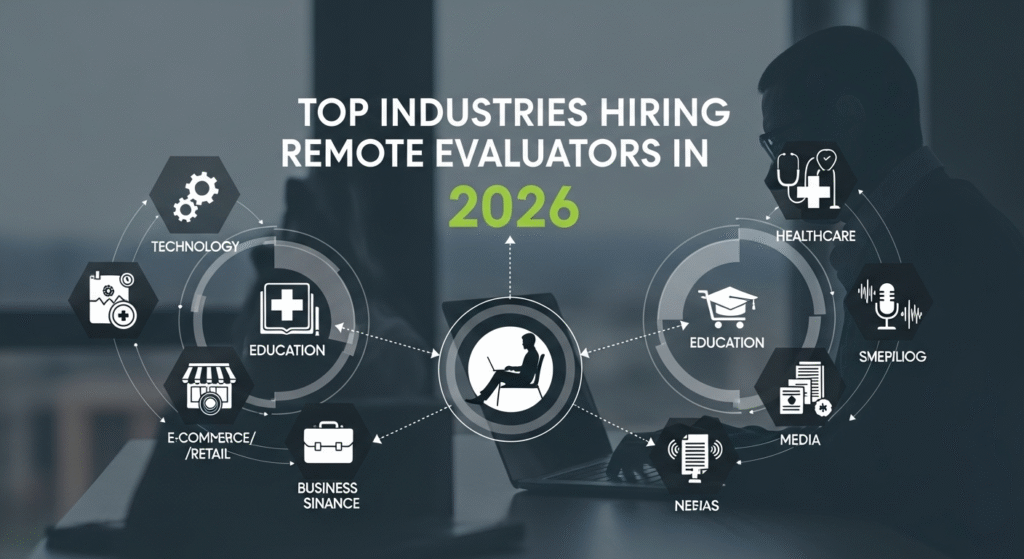
Remote evaluator trends show that more industries are adopting evaluation work than ever before.
These industries are hiring aggressively in 2026:
1. AI & Machine Learning Companies
They hire thousands of evaluators to improve:
- Chatbots
- Search systems
- Recommendation engines
2. Digital Advertising Companies
Evaluators help improve:
- Ad quality
- Policy compliance
- Engagement scoring
3. E-Commerce Platforms
Platforms need evaluators for:
- Product categorisation
- Content quality
- Data correctness
4. Social Media Companies
Evaluators ensure:
- Safety
- Relevance
- Brand friendly environments
5. Education & E-Learning
Evaluators review:
- Study guides
- Test questions
- Learning content
6. Cybersecurity & Risk
Specialised evaluators score:
- Harmful content
- Misinformation
- Fraud signals
7. Salary Trends & Earnings Forecast for 2026

Pay for remote evaluators has become more predictable and competitive.
Global average earnings (2026 forecast):
- $10–$22/hour for general evaluation
- $20–$35/hour for AI-focused tasks
- $30–$45/hour for specialised evaluation (legal, medical, technical)
Factors influencing pay:
- Location
- Language skills
- Task complexity
- Industry
- Certification level
Evaluators who specialise earn the highest rates.
8. Challenges Remote Evaluators Will Face in 2026

The field is expanding — but so is competition.
1. Rising Competition
More freelancers want remote jobs, meaning higher expectations.
2. Constant Skill Upgrading
AI evolves fast; evaluators must keep learning.
3. Irregular Work Cycles
Projects may come in waves.
4. Complex Guidelines
New evaluation projects have detailed rulebooks.
5. Performance Monitoring
Companies now track:
- Accuracy
- Consistency
- Speed
This can feel demanding but helps professionals improve.
9. How to Start or Advance Your Remote Evaluator Career in 2026

If you want to grow in this field, follow this clear roadmap.
Step 1: Learn the Basics
Understand:
- How evaluation works
- Types of tasks
- Basic tools
Step 2: Build Skills Through Self-Study or Short Courses
Focus areas:
- Data annotation
- AI evaluation
- UX research basics
Step 3: Start With Entry-Level Platforms
Some platforms accept beginners (no links mentioned here).
Step 4: Move Into Specialised Work
Grow into:
- Ads quality
- AI training
- Policy evaluation
- Search relevance
Step 5: Build Consistency & Quality
Companies prefer high-accuracy workers.
Step 6: Create a Portfolio of Completed Tasks
Document:
- Types of evaluation
- Skills gained
- Tools used
This helps when applying for higher-level roles.
Conclusion
The remote evaluation field is entering a major transformation as companies rely more heavily on human judgment to guide AI systems, rate content quality, and maintain safer digital environments. Evaluators are moving toward more specialised tasks involving data accuracy, policy interpretation, and multimodal content analysis. This shift is creating clearer career pathways, stronger earning potential, and more opportunities for workers who want long-term stability in online jobs.
The latest remote evaluator trends show that the role is evolving from simple rating work into a skilled profession where analytical thinking, AI literacy, and cultural understanding are essential. Professionals who focus on refining these abilities will stand out in a competitive market and gain access to higher-value projects. For anyone interested in building a dependable online career, 2026 offers the perfect environment to grow, specialise, and succeed in the expanding world of digital evaluation.
FAQs
1. What are the biggest remote evaluator trends in 2026?
Key trends include AI-supervising roles, video/audio evaluation, short-term projects, stricter quality standards, and preference for certified evaluators.
2. Is remote evaluation still a good career in 2026?
Yes. With AI growth and global digital expansion, remote evaluation offers higher pay, specialised roles, and long-term online career stability.
3. How much do remote evaluators earn in 2026?
General tasks: $10–$22/hr, AI-focused: $20–$35/hr, specialised work: $30–$45/hr. Skills, language, and certifications increase pay.
4. Do I need experience to become a remote evaluator?
Beginners can start on entry-level platforms, but specialised roles require skills in AI evaluation, data annotation, and content quality assessment.
5. What skills are most important for remote evaluators now?
Analytical thinking, AI literacy, data annotation, content evaluation, policy knowledge, clear feedback, and time management are key skills.
6. Are AI tools replacing remote evaluators?
No. AI tools assist evaluators, but humans are essential for accuracy, bias correction, and cultural nuance in AI outputs.
7. Which industries hire the most remote evaluators?
Top industries: AI/ML, digital advertising, social media, e-commerce, education, and cybersecurity.
8. What tools do remote evaluators use?
Evaluators use annotation dashboards, AI scoring tools, QA portals, policy review systems, and multimodal evaluation software.
9. Is remote evaluation flexible or full-time?
Most roles are flexible with hourly tasks, micro-projects, and seasonal cycles, though advanced evaluators can get stable retainers.
10. How can beginners start a remote evaluator career?
Learn basics, take short courses, start entry-level platforms, build a portfolio, and improve accuracy for higher-paying roles.