
A strong remote evaluator resume is essential if you want to stand out in today’s competitive online assessment industry. Recruiters look for candidates who can follow complex guidelines, analyse digital content, and deliver accurate evaluation results consistently. Your resume must show your technical skills, remote productivity, tool familiarity, and performance achievements — otherwise, you’ll be overlooked even if you’re qualified. The right resume format highlights your strengths, aligns with employer expectations, and helps you secure well-paid evaluator opportunities.
Online evaluator roles are evolving quickly as companies introduce new rating tools, AI-powered dashboards, and quality-control systems. Employers now want applicants who are analytical, detail-oriented, and adaptable to constant guideline updates. A well-structured application helps demonstrate your understanding of digital ecosystems, your ability to work independently, and your readiness to deliver unbiased assessments across content, ads, search queries, relevance, safety, and quality tasks.
What Is a Remote Evaluator and What Do They Actually Do?
A remote evaluator is a professional who assesses online content, ads, search results, and digital data based on strict guidelines. These roles play an essential part in improving user experience, search engine accuracy, and platform safety.
Typical responsibilities include:
- Rating search result relevance
- Evaluating advertisements for quality and policy compliance
- Reviewing content for safety, accuracy, and intent
- Analysing user behavior data
- Providing feedback to improve AI systems
- Following step-by-step rating manuals and workflows
- Reporting inconsistencies in data or model output
Companies that frequently hire evaluators include:
- Telus International
- Appen
- RaterLabs
- Welocalize
- Teemwork.ai
- OneForma
These jobs offer flexibility, location independence, and consistent income — but competition is high. This is why your resume must clearly communicate your capability to work with minimal supervision and deliver consistent quality.
Why Employers Care About Your Resume Structure
Recruiters scan online evaluator resumes in under 8–12 seconds. They look for keywords, formatting, and proof of performance. If your resume is cluttered, vague, or lacks metrics, they move on.
What employers scan for immediately:
- Relevant experience (even if unrelated, transferable skills matter)
- Experience with rating, reviewing, or auditing tasks
- Accuracy rates or productivity metrics
- Familiarity with remote work tools
- Technical and analytical skills
- Ability to follow detailed instructions
Why structure matters:
Companies like Telus and Appen evaluate thousands of resumes every month. A clean, keyword-rich, data-driven resume gets shortlisted faster.
Key Resume Sections Recruiters Expect
| Resume Section | Why It Matters | What to Include |
|---|---|---|
| Contact Details | Immediate identification | Email, location (city only), LinkedIn |
| Professional Summary | First impression | 3–4 lines of achievements & skills |
| Skills | Quick filtering | Technical, analytical, soft skills |
| Work Experience | Primary evaluation | Metrics, results, tools used |
| Education | Background check | Degrees, relevant courses |
| Certifications | Shows credibility | AI, analytics, QA, data training |
| Tools & Platforms | Job relevance | Rating tools, dashboards, software |
How to Write a Remote Evaluator Resume Step-by-Step
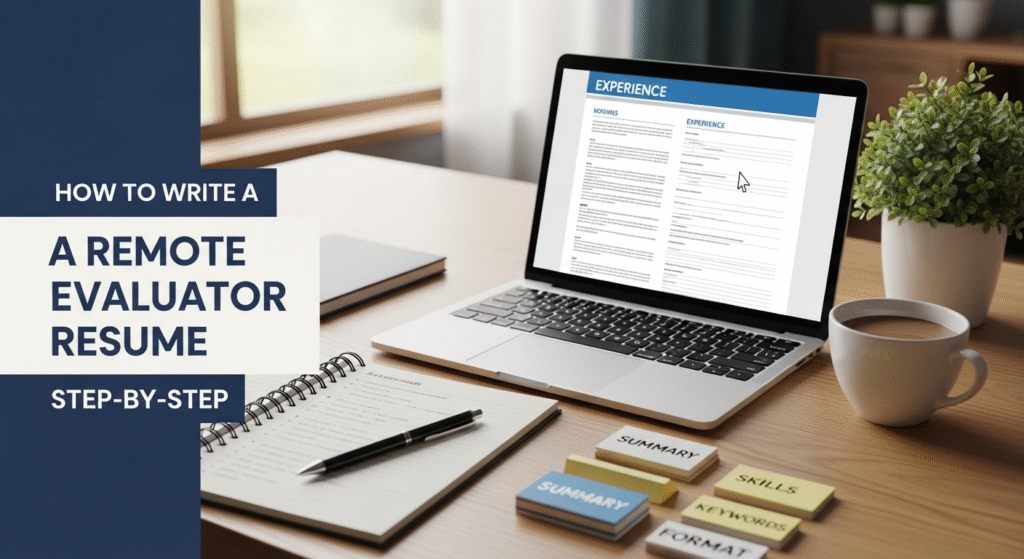
Hiring managers look for resumes that are clear, credible, and aligned with evaluation tasks. Below is a complete framework to help you build a winning application.
Step 1: Write a Strong Summary That Shows Your Value Immediately
Your resume summary should instantly communicate your strongest qualities. Keep it short, measurable, and tailored to online evaluation.
Example of a Strong Summary
Analytical and detail-oriented digital evaluator with 2+ years of experience reviewing content, rating search results, and refining AI-driven datasets. Skilled in guideline interpretation, accuracy scoring, and productivity management with a consistent 97–99% quality rating. Adept at working independently, meeting weekly quotas, and delivering unbiased assessment across multiple categories.
Why this works:
- Uses measurable results
- Includes evaluation keywords
- Shows technical and analytical competence
Step 2: Add Skills That Match Evaluation Tasks
Make sure you include both hard and soft skills.
Hard Skills
- Search evaluation
- Data labeling
- Online content review
- Ad quality rating
- Guideline interpretation
- Policy compliance review
- Query intent analysis
- Categorization & annotation
- Dashboard navigation
- AI training workflows
Soft Skills
- Critical thinking
- Detail orientation
- Time management
- Problem-solving
- Remote communication
- Consistency & reliability
Top Skills Employers Want in 2025
| Skill Type | Skill Name | Why It Matters |
|---|---|---|
| Technical | Search relevance evaluation | Ensures accurate results |
| Analytical | Intent analysis | Improves search matching |
| Quality | Accuracy performance | Reduces errors |
| Communication | Written explanations | Validates evaluation decisions |
| Productivity | Task completion speed | Helps meet weekly quotas |
Step 3: Show Experience Using Metrics, Not Vague Claims
Employers prefer results, not descriptions.
Weak Experience Example
- Reviewed content and ads
- Completed evaluation tasks
- Followed guidelines
(This tells the recruiter nothing.)
Strong, Metric-Based Example
Digital Evaluator — Telus International (2023–2025)
- Completed 350+ weekly evaluation tasks across ads, content relevance, and search categories
- Maintained 98% accuracy score, ranking in the top 10% of evaluators
- Analysed over 10,000 data points to identify quality issues, improving overall dataset reliability
- Applied updated rating guidelines with zero policy violations over 12 months
- Delivered consistent written justifications to support evaluation decisions
- Flagged 200+ incorrect categorisations, improving model training outputs
Why this works:
- Each bullet carries measurable achievements
- Quantified credibility increases trust
- Shows technical understanding of evaluator tasks
Step 4: Certifications That Improve Your Resume
Certifications are not mandatory, but they dramatically strengthen your resume.
Recommended Certifications
- Coursera: Data Analysis / AI Basics
- Google: Digital Marketing & Analytics
- HubSpot: Content & Data Certification
- LinkedIn Learning: Quality Assurance or Analytics
- Udemy: Prompt Engineering & AI Fundamentals
Certifications show commitment, technical understanding, and capability to learn new systems quickly.
How to Format Your Remote Evaluator Resume for Maximum Impact
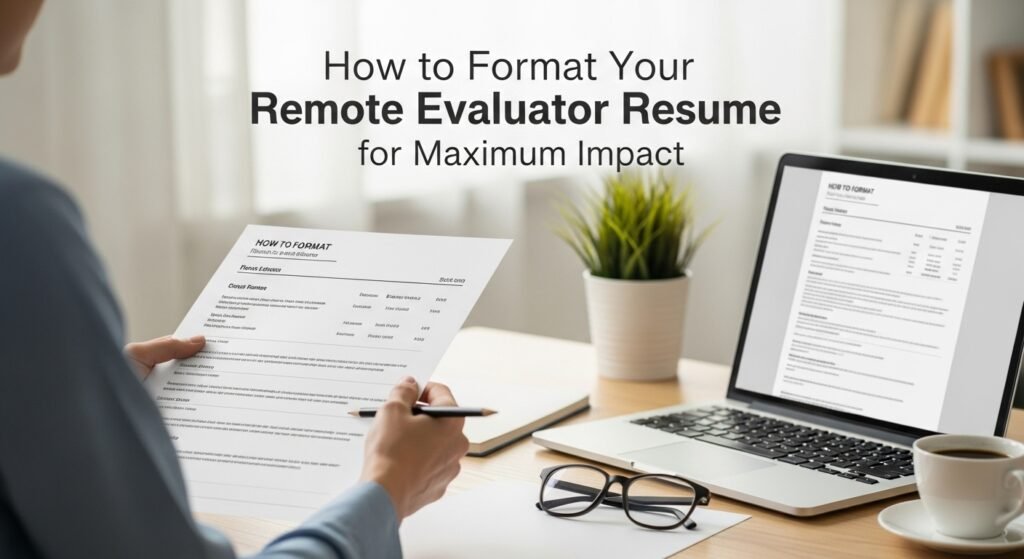
Formatting determines whether a recruiter reads or rejects your resume. Clean formatting boosts readability and conversion.
Must-follow formatting rules:
- Keep it to one page (two pages only if you have extensive experience).
- Use a professional, readable font: Arial, Calibri, Inter, Helvetica.
- Use bold for important metrics.
- Use bullet points, not long paragraphs.
- Maintain consistent spacing throughout.
- Avoid icons, graphics, or clutter — evaluator roles value clarity.
- Use simple, ATS-friendly formatting.
ATS keywords to include naturally:
- Quality Rater
- Search Relevance
- Data Evaluator
- Ad Reviewer
- Guideline Interpretation
- Accuracy Score
- Productivity Metrics
Common Mistakes to Avoid in a Remote Evaluation Resume
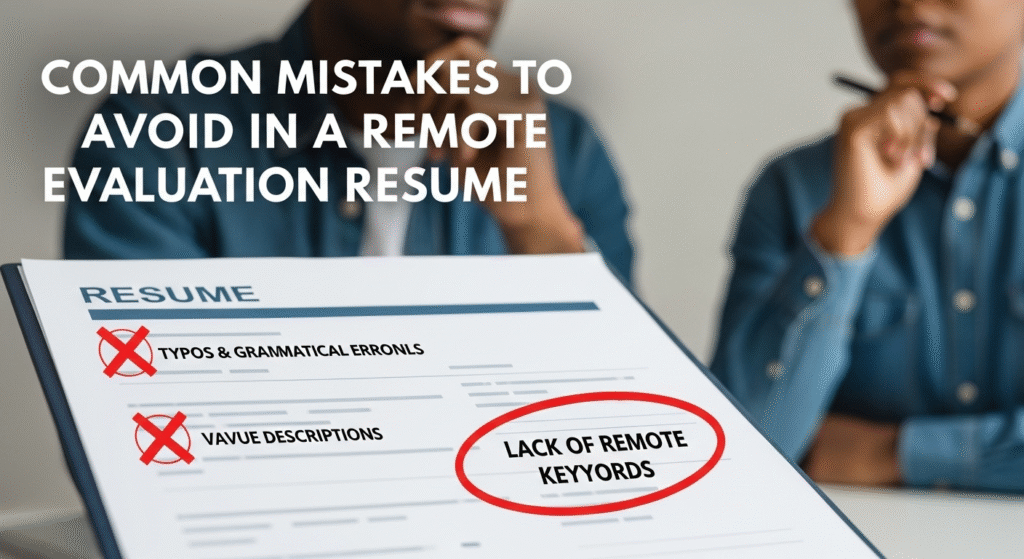
Many candidates lose job opportunities because of small resume mistakes.
Avoid these common issues:
- Not including metrics
- Writing generic bullet points
- Missing evaluator keywords
- Overcomplicated design or graphics
- Submitting a resume without proofreading
- No demonstration of remote discipline
- Not highlighting accuracy or quality scores
- Listing irrelevant work without transferable skills
Biggest Resume Mistakes vs. How to Fix Them
| Mistake | Why It’s a Problem | Fix |
|---|---|---|
| No metrics | Lacks credibility | Add accuracy %, tasks per week |
| Vague skills | Looks generic | Use evaluator tasks and tools |
| Poor formatting | Hard to read | Clean, ATS-friendly layout |
| No certifications | Lower ranking | Add free or low-cost courses |
| Long paragraphs | Low readability | Use short bullets |
What Should a Remote Evaluator Resume Include?
A remote evaluator resume should include a summary, skills, metrics-based experience, remote tools, certifications, and technical competencies. Use measurable results, evaluator keywords, and a clean layout to improve your hiring chances.
Checklist:
- Summary with achievements
- 12–18 skills
- Metrics-based experience
- Remote work discipline
- Technical tools
- Certifications
- Clear ATS formatting
Professional Remote Evaluator Resume Example
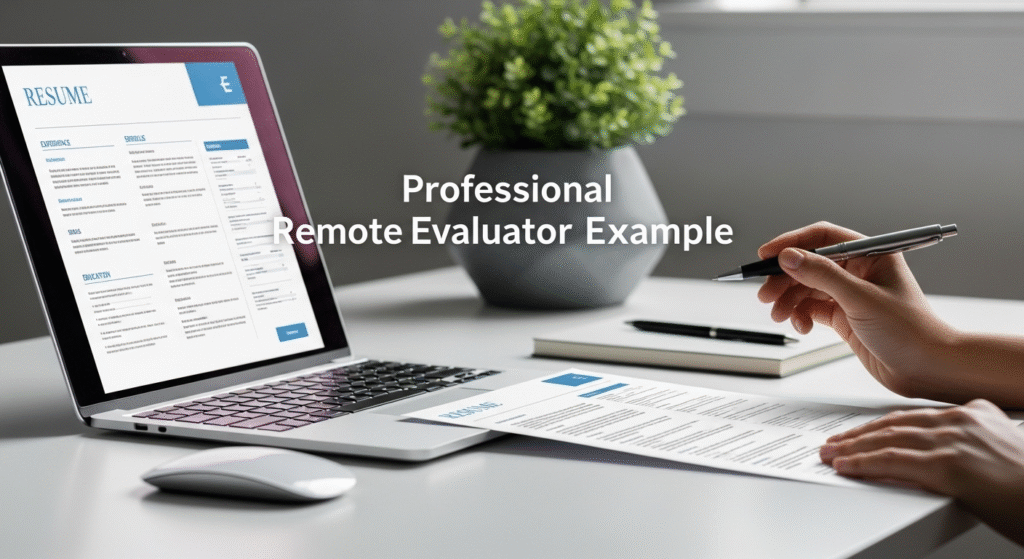
Below is a polished, ATS-friendly example you can use as inspiration or copy into your own template.
Professional Summary
Detail-oriented remote evaluator with 2+ years of experience rating search queries, reviewing digital content, and performing ad quality assessments. Strong analytical skills with a proven 98% accuracy score and consistent weekly task completion. Skilled in guideline interpretation, data analysis, and delivering reliable feedback for AI model improvements.
Core Skills
- Search relevance evaluation
- Ad content scoring
- Policy and guideline interpretation
- Data categorization
- AI training feedback
- Content quality assurance
- Query intent analysis
- Productivity and time management
Professional Experience
Digital Evaluator — Telus International (2023–2025)
- Completed 350–500 tasks per week across ads, search, content, and safety categories
- Achieved consistent 98% accuracy, ranking in top evaluator tier
- Reviewed over 10,000+ digital data items across multiple categories
- Identified and corrected 200+ miscategorized items, improving dataset accuracy
- Provided detailed written justifications for evaluation decisions
- Managed workload independently with zero missed deadlines
Content Reviewer — Appen (2021–2023)
- Performed content safety checks and quality reviews across multiple projects
- Assessed intent and policy compliance for 5,000+ content items
- Ensured full adherence to rating guidelines during updates
- Maintained an ongoing 95%+ accuracy score
- Worked with complex rating dashboards and tagging tools
Education
Bachelor’s Degree in Communications — 2021
University of XYZ
Certifications
- Coursera: Foundations of Data Analysis
- Google Analytics Certification
- LinkedIn Course: Digital Content Evaluation
Tools
- Telus AI Rating Dashboard
- Appen Contributor Portal
- Excel / Sheets
- Jira / Trello / Asana
- Slack / Teams
Free Remote Evaluator Resume Template
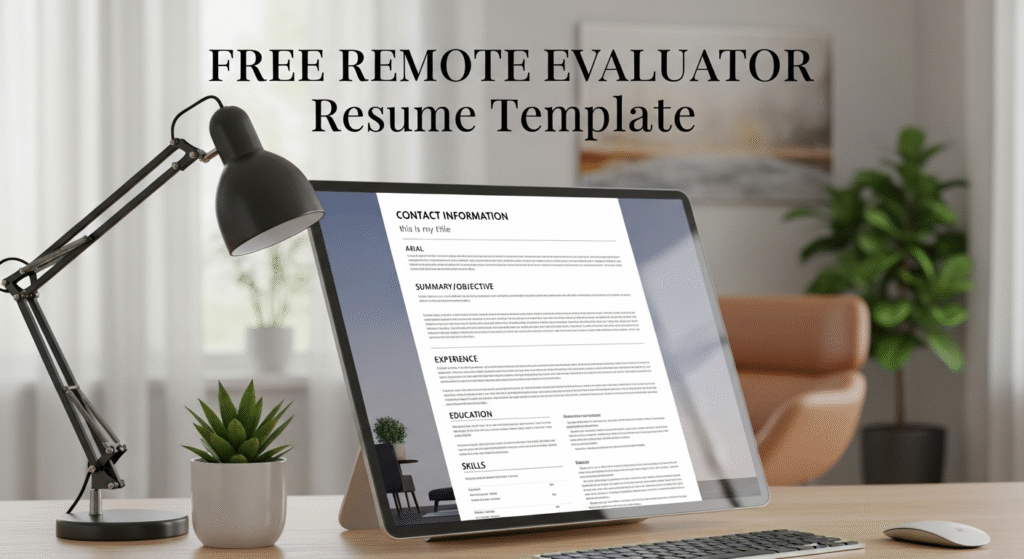
[Full Name]
City, Country | Email | LinkedIn
SUMMARY
A concise 3–4 line summary highlighting accuracy, analytical skills, and evaluation experience.
SKILLS
- Add 12–18 evaluator, analytical, and remote productivity skills
EXPERIENCE
Role Title — Company — Dates
- Bullet point with metrics
- Bullet point with weekly task numbers
- Bullet point showing accuracy score
- Bullet point showing guideline mastery
EDUCATION
Degree | Institute | Year
CERTIFICATIONS
List relevant free or paid courses
TOOLS
AI rating tools, dashboards, remote tools
How to Make Your Resume Stand Out to Recruiters
You can enhance your application further by showcasing qualities that evaluators must display daily.
Tips for extra impact:
1. Add your accuracy scores
Including accuracy percentages (like 97–99%) proves you deliver consistent, high-quality evaluations. It quickly builds trust and shows recruiters you follow guidelines correctly.
2. Add your task completion speed
Sharing your average tasks per day or week highlights your productivity. Recruiters want evaluators who can work fast without compromising accuracy.
3. List the categories you evaluated
Mentioning categories like ads, search results, or content safety shows your versatility. It helps recruiters match you with specific projects that need those skills.
4. Add any quality feedback you received
Positive comments from past projects show reliability and strong performance. This makes your resume more credible than generic skill claims.
5. Highlight experience with policy-based evaluation
Policy and safety evaluation experience proves you can apply complex guidelines correctly. This is valuable for high-trust tasks involving sensitive content.
Conclusion
Building a strong foundation for your evaluator career starts with presenting your skills, accuracy, and analytical abilities in a clear and compelling format. Recruiters rely heavily on measurable performance, adaptability, and your ability to follow complex instructions without supervision. When your resume highlights accuracy scores, productivity metrics, and experience across different evaluation categories, it instantly communicates your readiness for real-world tasks. This is what helps you stand out in a field where precision, consistency, and independent work are essential for success.
A well-crafted remote evaluator resume is more than just a document — it’s a strategic representation of your capability to improve search results, assess digital content, and support AI training systems. Including achievements, certifications, remote work discipline, and the tools you’ve mastered helps employers understand the value you bring. When you refine each section with relevant metrics and tailor your resume to match specific evaluation projects, you maximize your chances of securing flexible, long-term opportunities with leading global platforms.
FAQs
1. What should a remote evaluator resume include?
A strong remote evaluator resume should include a summary, skills, metrics-based work experience, accuracy scores, task volume, remote tools, certifications, and evaluator-specific keywords. Make sure each section highlights measurable achievements.
2. Do I need previous evaluator experience to apply?
No, you don’t need prior evaluator experience. Many companies hire beginners if they show strong analytical skills, attention to detail, and the ability to follow guidelines. Transferable skills from QA, customer service, auditing, or data entry can also help.
3. How long should my remote evaluator resume be?
One page is ideal, especially for new applicants. If you have multiple evaluator roles or several relevant achievements, a two-page resume is acceptable — but keep it clean, concise, and focused on measurable results.
4. Which skills matter most for remote evaluator jobs?
Companies look for search relevance skills, policy interpretation, content rating, data labelling, accuracy performance, communication skills, and strong time management. Showing both technical and analytical strengths increases your hiring chances.
5. Do accuracy scores really matter on a resume?
Yes. Accuracy scores (like 95–99%) are one of the strongest indicators of evaluator quality. They help recruiters trust your work and immediately signal that you can follow guidelines consistently.
6. What tools should I list on my resume?
Include evaluator dashboards, annotation tools, Google Sheets, Excel, task management apps (Asana, Trello), and communication tools like Slack or Teams. Mention any platform-specific tools you’ve used in Telus, Appen, OneForma, or RaterLabs projects.
7. How do I write experience if I’ve never worked as an evaluator?
Use transferable achievements from past jobs: accuracy, analysis, compliance, quality assurance, reporting, or remote productivity. Focus on detail-oriented tasks, reviewing content, following instructions, or meeting deadlines — these fit evaluator roles perfectly.
8. What format works best for a remote evaluator resume?
Use a clean, ATS-friendly layout with simple fonts, clear spacing, and bullet points. Add measurable metrics and avoid graphics or complex designs. Recruiters skim remote evaluator resumes quickly, so simplicity works best.
9. Are certifications required?
Not required — but they help you stand out. Certifications in AI basics, data analysis, digital marketing, QA, or content evaluation show commitment and improve your credibility as a candidate.
10. How do I make my resume stand out from other applicants?
Include metrics (accuracy %, task volume), list evaluator categories you’ve handled, add positive quality feedback, and show experience with policy-based evaluations. Recruiters prioritize candidates who demonstrate proven performance and clear analytical ability.